---
title: "Chasing the Sunrise at Borobudur: A Mindful Morning Guide"
description: "How the Borobudur sunrise actually works: the three different dawn options, timings, costs, and what to expect when the light fails."
date: 2026-07-25
lastReviewed: 2026-10-05
category: heritage
image: "/images/borobudur-sunrise.webp"
pinterestImage: "/images/pin-borobudur-sunrise-guide.webp"
imageAlt: "Golden sunrise over Borobudur Temple with misty mountains in the background"
location: "Borobudur area, Magelang Regency"
tripStage: before-you-go
products:
- headlamp-multi
- daypack-packable
- rain-windbreaker
- water-bottle-1l
- insect-repellent-picaridin
related:
- collection: guides
slug: borobudur-tickets-and-climb
- collection: guides
slug: borobudur-temple-rules
- collection: attractions
slug: punthuk-setumbu-sunrise
keyFacts:
- label: "Cheapest sunrise option"
value: "Dawn at Punthuk Setumbu hill, off-site, near-zero cost"
- label: "On-monument sunrise"
value: "Around IDR 1,000,000 via Manohara, capped at 100 people per day"
- label: "On-monument access time"
value: "Roughly 04:00-04:30, before public opening"
- label: "Temple height"
value: "Around 30-35 m above the base"
- label: "Shade on the structure"
value: "None — this is why dawn or late afternoon matters"
- label: "Relief panels"
value: "2,672, read clockwise on the galleries"
- label: "Stupas on the upper terraces"
value: "72 perforated stupas around the central stupa"
- label: "Best season for a clear sunrise"
value: "Dry season, roughly April to October"
sources:
- label: "UNESCO: Borobudur Temple Compounds"
url: "https://whc.unesco.org/en/list/592/"
- label: "Britannica: Borobudur"
url: "https://www.britannica.com/topic/Borobudur"
- label: "InJourney Destination (official temple operator)"
url: "https://injourneydestination.id"
- label: "BMKG — Indonesia Meteorology, Climatology, and Geophysics Agency"
url: "https://www.bmkg.go.id/"
ecoTip: "The cheapest sunrise is also the lowest-impact one. Punthuk Setumbu is a walk-up hill outside the ticketed park, so a dawn visit there costs the park nothing and generates no ticket revenue for anyone."
familyTip: "A 04:30 start is rough on small children. The on-monument sunrise is a poor family choice; Punthuk Setumbu at civil dawn, or the ordinary morning entry once the park opens, suits families far better."
localSecret: "The on-monument sunrise sells out well in advance and is capped at 100 people a day. If it is genuinely important to you, that cap is the reason to book early rather than the price."
---
Borobudur is a major Buddhist monument within the UNESCO-listed Borobudur Temple Compounds. It is also a protected cultural landscape and a place of ongoing religious significance, not merely a viewpoint. A useful visit begins with realistic expectations: access arrangements, visitor flows, and weather can all change, so confirm current rules with the official operator before you travel.
This guide is for planning a respectful early visit, not for guaranteeing a sunrise photograph. Light, cloud cover, and permitted entry times are outside any visitor's control. If dawn access matters to your itinerary, make it the first detail you verify when booking.
## The first thing to understand: there are three sunrises
Most confusion about Borobudur and sunrise comes from a single problem — there is more than one thing being sold under the name "Borobudur sunrise," at wildly different prices, and they are not the same experience.
**The dawn viewpoint at Punthuk Setumbu.** A hill about 3 km from the temple, reached on foot or by a small fee for local transport. You watch the sun come up over the silhouette of Borobudur and the hills behind it. This costs almost nothing, takes a 30 to 45 minute climb, and requires no ticket to Borobudur at all. It is the experience that most photographs of "Borobudur sunrise" actually show, and it is available to anyone.
**The ordinary morning entry.** Borobudur's grounds open to ticketed visitors in the morning, and by mid-morning the light on the monument is good. You arrive with the general public, walk the galleries, and can climb the structure if you have bought that ticket. This is not a sunrise but it is the most flexible option and the one most visitors actually use. See the [Borobudur tickets and Structure Climb guide](/guides/borobudur-tickets-and-climb/) for current hours and prices.
**The on-monument sunrise.** A separate, capped product run through the Manohara Borobudur Cultural Center, giving access to the monument itself before public opening, at around 04:00 to 04:30. It has been quoted at around IDR 1,000,000 for international visitors, and is limited to 100 people per day. This is the expensive option and the only one that puts you physically on the structure at dawn.
Work out which of the three you actually want before booking anything. Booking the expensive one by mistake because you assumed all "Borobudur sunrise" products are the same is the single most common and most expensive mistake here. The [Punthuk Setumbu guide](/attractions/punthuk-setumbu-sunrise/) covers the hill option properly.
Borobudur seen against the hills, a reminder that the monument sits within a wider living landscape.
## Start with the right checks
Before leaving your accommodation, confirm these items with the current operator or your accommodation:
- Which areas are open on your visit date, and whether temple access is included in your ticket.
- The ticket type, booking process, and arrival instructions currently in force.
- Any clothing, footwear, bag, photography, or guided-tour requirements.
- Rain, lightning, or crowd-management notices that could affect the visit.
The [UNESCO listing](https://whc.unesco.org/en/list/592/) explains why the monument is protected. It is worth reading before you arrive — not for rules, but so that what you are walking through has context.
One practical warning. The widely copied third-party ticket and tour sites are frequently out of date on Borobudur specifics. Several still quote a Monday closure and an 08:30 to 15:30 climb window, neither of which matches the current operator's own announcements. Check at the operator's official booking channel rather than trusting a search result.
## What you are actually walking through
Borobudur is a pyramidical Buddhist temple-mountain of roughly 30 to 35 metres, built around 800 AD under the Sailendra dynasty. Britannica describes it in exactly those terms: galleries of bas-reliefs joined by stairways, leading up through platforms to a large empty stupa at the peak.
A few numbers help you calibrate expectations:
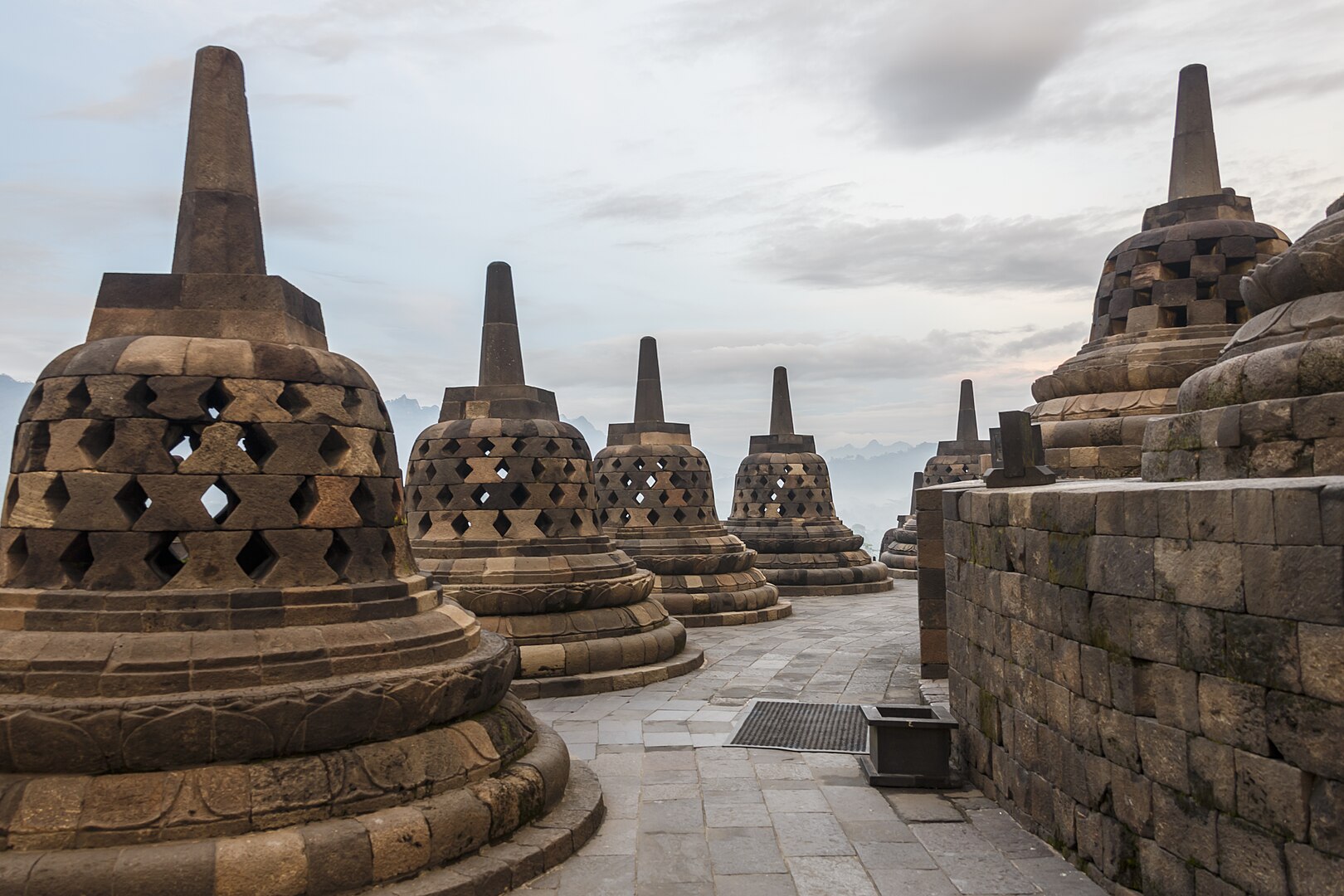
It was built from around 2 million blocks of volcanic stone. There are **2,672 relief panels** on the galleries, read clockwise in a continuous narrative. The upper terraces are ringed by **72 perforated stupas** around the central stupa. It originally held around **504 Buddha statues**, many of which are now headless or missing following looting and colonial-era collection. The base measures roughly **123 by 123 metres**.
The important practical consequence of all this is the absence of shade. There is essentially none on the upper structure. Combined with a 30-plus metre climb and volcanic stone steps, this is why dawn and late afternoon are the sensible times and midday in the dry season is not.
For the full history, restoration, and architectural reading, the [Borobudur temple guide](/attractions/borobudur-temple-guide/) goes into detail. Read it before you go — it genuinely changes what you see.
The upper terraces ringed with stupas, best approached calmly and on the marked route.
## Plan a calm morning
Allow time for the journey, parking or drop-off procedures, security checks, toilets, and an unhurried walk. Avoid building a tightly timed itinerary around a single view. Weather can change quickly, and a quieter visit is often more rewarding than chasing a specific photograph.
If you are travelling from Yogyakarta or Magelang, ask your accommodation or licensed transport provider for a current departure plan. Confirm the exact entrance used by your ticket rather than assuming every route serves the same gate.
**On the climb specifically.** The structure climb requires the mandatory Upanat — woven pandanus sandals issued by size at a counter, and yours to keep as a souvenir, introduced to protect the volcanic stone steps. You walk to the temple base in your own shoes, swap to the Upanat, and swap back at the exit, so bring a small bag for your footwear. The session is guided and capped at around 90 minutes.
**On the way out.** There is a mandatory walk of roughly a kilometre through a dense souvenir-stall maze. Ask staff for a shortcut or a buggy exit if mobility is an issue, rather than discovering it on the way out.
## When to go, honestly
If a clear sunrise is a genuine priority, the **dry season of roughly April to October** is when you have the best odds. The wet season of November to March brings heavy rain, and while it does not close the site, it regularly forces visitors off the exposed stone structure and produces flat, grey dawns.
Weather at dawn in Central Java is genuinely unreliable even in dry season. Check [BMKG](https://www.bmkg.go.id/) the evening before and the morning of. The [best time to visit Magelang guide](/guides/best-time-to-visit-magelang/) covers the seasonal picture in more detail, including why shoulder season is usually the better trade.
Worth knowing: **Vesak or Waisak**, the annual full-moon festival, brings thousands of monks and pilgrims processing from Mendut to Borobudur. It is a remarkable thing to witness and a genuinely bad time to plan a quiet visit, because entry arrangements change substantially for the period.
## Visit with respect
Borobudur is not a backdrop. Keep voices low, follow the marked route and staff instructions, and do not touch or lean on carved stonework. There are firm prohibitions — tripods and selfie sticks are not permitted on the structure, food and drink other than water are not allowed in the inner compound, and touching reliefs or Buddha statues is prohibited.
Dress with shoulders and knees covered. There is no formally published general dress code, but it is the strong convention, and a free batik sarong is available at the gate if you need one.
The [Borobudur rules and etiquette guide](/guides/borobudur-temple-rules/) has the full list of what you may not do, and is worth reading the night before rather than at the gate.
Choose a guide or activity provider only after checking credentials, inclusions, cancellation terms, and current visitor rules. For a lower-waste day, carry a refillable bottle, refuse unnecessary single-use packaging, and keep food and litter away from the monument.
## What to bring
- Comfortable footwear suitable for stone steps and changing weather.
- A light rain layer, sun protection, and a hat.
- Drinking water — and note you cannot drink while on the structure itself, so fill up at the entrance stations.
- A charged phone with booking details saved offline, in case signal is poor.
- Modest, breathable clothing and a small bag for your footwear swap.
- Cash, for small vendors, lockers, and any incidental fees.
The [what to wear and pack for Borobudur guide](/gear/borobudur-what-to-wear-and-pack/) expands on all six of these, and explains the three rules that catch almost everyone: the bag size limit, the footwear swap, and the fact that only water is allowed inside.
## Putting the morning together
A dawn at Punthuk Setumbu, then the temple once it opens, works well: the viewpoint is closest to the light and the ticket entry is closer to the crowds. Pair it with the heritage axis — the [Mendut temple guide](/attractions/mendut-temple-guide/) and [Pawon temple guide](/attractions/pawon-temple-guide/) explain how those two relate to Borobudur and can be walked in the same half-day.
The [one-day itinerary](/guides/magelang-one-day-itinerary/) and [two-day itinerary](/guides/magelang-two-day-itinerary/) place this in a fuller plan. The [Magelang budget guide](/guides/magelang-budget-guide/) covers what the different options cost, which matters a great deal given the price difference between the three sunrise options above.
For a gentler, family-friendly landscape stop later in the day, the [Propang Ranch guide](/attractions/propang-ranch-guide/) works well on a relaxed afternoon. And the [sustainable travel guide](/guides/sustainable-travel/) covers how to keep the whole day lower-impact.