---
title: "A 3-Day Magelang Itinerary: Heritage, Hills & Food"
description: "A three-day Magelang itinerary built around one focus per day, with the road transfers, weather swaps and food stops that make it actually work."
date: 2026-10-05
lastReviewed: 2026-10-05
category: guide
image: "/images/punthuk-setumbu.webp"
pinterestImage: "/images/pin-magelang-3-day-itinerary.webp"
imageAlt: "Borobudur Temple silhouette in morning haze seen from Punthuk Setumbu"
imageCredit:
label: "Focusfeel, CC BY-SA 4.0 via Wikimedia Commons"
url: "https://commons.wikimedia.org/wiki/File:Amazing_Borobudur.jpg"
location: "Magelang region"
tripStage: before-you-go
keyFacts:
- label: "Structure"
value: "One main focus per day — heritage, landscape, then community and food"
- label: "Total driving"
value: "Roughly 2–4 hours across three days, mostly on narrow local roads"
- label: "Hardest single transfer"
value: "Magelang City to Ketep Pass or to the highland villages, about 30 km each way"
- label: "Heritage anchor"
value: "Mendut, Pawon and Borobudur sit on one line, about 3 km end to end"
- label: "Weather-dependent day"
value: "Day 2 is the one to move or swap — everything else holds in any weather"
- label: "Booking"
value: "Borobudur Structure Climb and any Structure Climb guide session are booked ahead"
- label: "Cash"
value: "Needed for temple fees, village entries, small workshops and market stalls"
- label: "Best base"
value: "Borobudur village or the Mendut end of the axis, not the city centre"
related:
- collection: guides
slug: magelang-two-day-itinerary
- collection: guides
slug: magelang-one-day-itinerary
- collection: guides
slug: where-to-stay-near-borobudur
ecoTip: "Group nearby activities, refill water where appropriate, and keep a weather backup instead of making repeated long trips to chase a single view."
familyTip: "Plan one main activity per day, with food, shade, and a simple indoor or low-effort alternative ready for tired children or poor weather."
sources:
- label: "UNESCO: Borobudur Temple Compounds"
url: "https://whc.unesco.org/en/list/592/"
- label: "InJourney Destination — official Borobudur operator"
url: "https://injourneydestination.id"
- label: "Indonesia Meteorology, Climatology, and Geophysics Agency (BMKG)"
url: "https://www.bmkg.go.id/"
- label: "MAGMA Indonesia — volcanic activity bulletins"
url: "https://magma.esdm.go.id/v1"
faq:
- q: "Is three days the right length for Magelang?"
a: "It is the shortest length that lets you see the heritage axis properly without rushing it, and the longest that still works without a private car and driver for the whole trip. Two days works if you drop the highland day. Four or more only earns its length if you are adding the northern temples, the highland villages, or a rest day."
- q: "Do I need a private driver for three days?"
a: "Not strictly. The heritage axis and the town food stops are reachable on public transport and short transfers. The problem is Day 2: if you pick Ketep Pass or a highland village, you will want a vehicle for the day, either pre-booked through your accommodation or hired locally. Ask your base the night before rather than on the morning."
- q: "What if it rains on Day 2?"
a: "Swap Days 1 and 2 rather than cancelling anything. The heritage axis works in rain because the temples are solid stone and Mendut is an enterable shrine you can use in poor light. Day 3's food stops are indoor. Day 2 is the only genuinely weather-exposed piece, which is exactly why it is the one built to move."
- q: "Can I do the Structure Climb and still have an evening?"
a: "Yes. The official climb window is 09:00 to 17:00 daily, so a morning slot leaves the afternoon free. Do not attempt it at dawn as a casual visitor — that is a separate, much more expensive product. Book ahead, expect a mandatory local guide and a change into Upanat sandals at the base."
- q: "Which day should be Day 1?"
a: "The heritage day. It is the most reliable, it gives you context for everything else, and if you arrive tired it is the day that still works. Put the flexible day second so you have already done the thing that cannot be cancelled."
- q: "How much driving is three days really?"
a: "Around two to four hours in total spread across three days, but concentrated into two hard transfers: out to the highland or volcano viewpoint and back. The heritage axis itself is only about three kilometres end to end and is comfortably walkable or a short hop."
- q: "Is Vesak a good time to run this itinerary?"
a: "No. Vesak brings thousands of monks and pilgrims processing from Mendut to Borobudur, and entry arrangements change substantially. If that is why you are coming, plan a different trip. If it is not, avoid those dates rather than trying to fit around a moving crowd."
- q: "What should I book before arriving?"
a: "The Borobudur Structure Climb session, any accommodation with a specific pool or shuttle requirement, and any workshop in the Wanurejo craft village that you want to actually walk into. Everything else in this itinerary can be decided on the day."
---
This three-day Magelang itinerary is a flexible planning framework, not a promise of fixed travel times, prices, or access. It is built around one main focus per day: heritage, landscape, and community life with food. Before each day, confirm current visitor rules, transport, weather, and any booking requirement with the relevant operator or your accommodation.
The single most useful thing to understand before reading the days below is the shape of the region. Magelang Regency covers roughly 1,085 km², and the attractions people want to see are spread across it. Borobudur sits just south of Magelang city. Ketep Pass is about 30 km north of the city. The highland villages sit southeast of it. Kayang Waterfall is east. Almost every day ends with a road transfer, and those transfers are the part that decides whether the day feels relaxed or rushed.
## Before You Start: Two Decisions That Shape Everything
**Where you sleep.** A three-day plan lives or dies on its base. Magelang city, the Borobudur area, and the highlands serve genuinely different itineraries, and they are not interchangeable — Borobudur village and Magelang city are roughly 20 to 25 km apart. The [where to stay near Borobudur guide](/guides/where-to-stay-near-borobudur/) sets out the trade-offs honestly, but the short version is this: if your plan includes the heritage axis, stay on the Borobudur end or on the Mendut and Pawon end of that axis. If your plan leans on Ketep Pass or the northern temples, a city base is more central.
**What you will book ahead.** Almost nothing on this itinerary needs booking in advance. The exception is the Borobudur Structure Climb, which runs as guided sessions in a published window and should be reserved. The [Borobudur tickets and Structure Climb guide](/guides/borobudur-tickets-and-climb/) covers the price differences between the climb ticket and the grounds-only ticket, because that choice changes your whole Day 1 and is the most common thing visitors get wrong.
Save your transport contacts, your bookings, and offline maps before you lose Wi-Fi. Check [BMKG](https://www.bmkg.go.id/) for forecasts and warnings before each outdoor plan. The [best time to visit Magelang guide](/guides/best-time-to-visit-magelang/) explains how to build weather flexibility into your dates rather than around them.
## Day 1: The Heritage Axis, Done Properly
Make the first day the heritage day, because it is the one that works in any weather and the one that gives the rest of the trip its context.
The axis runs Mendut, Pawon, Borobudur on a straight line, roughly 3 km end to end. UNESCO lists all three together as the Borobudur Temple Compounds, and treating them as one connected landscape rather than three separate tickets is the difference between a good day and a stressful one.
Start at [Mendut](/attractions/mendut-temple-guide/). It is the oldest of the three, from the early 9th century, and — this is what most visitors do not expect — it is an enterable shrine. You go inside, past a vestibule carved with deities carrying offerings, to a sanctum holding three seated Buddhas each carved from a single block of stone. Borobudur's stupa can only be walked around; Mendut can be entered. That difference makes it the right place to start, in the cooler light and before the crowds build.
Then [Pawon](/attractions/pawon-temple-guide/), the smallest of the three, sitting between Mendut and Borobudur. Its interior is the interesting part. UNESCO notes that its inner space does not identify the deity that may once have been worshipped there, and the leading reading is that it functioned as an ablution or purification pavilion serving Borobudur rather than as a temple in its own right. Uncertain scholarship is still scholarship.
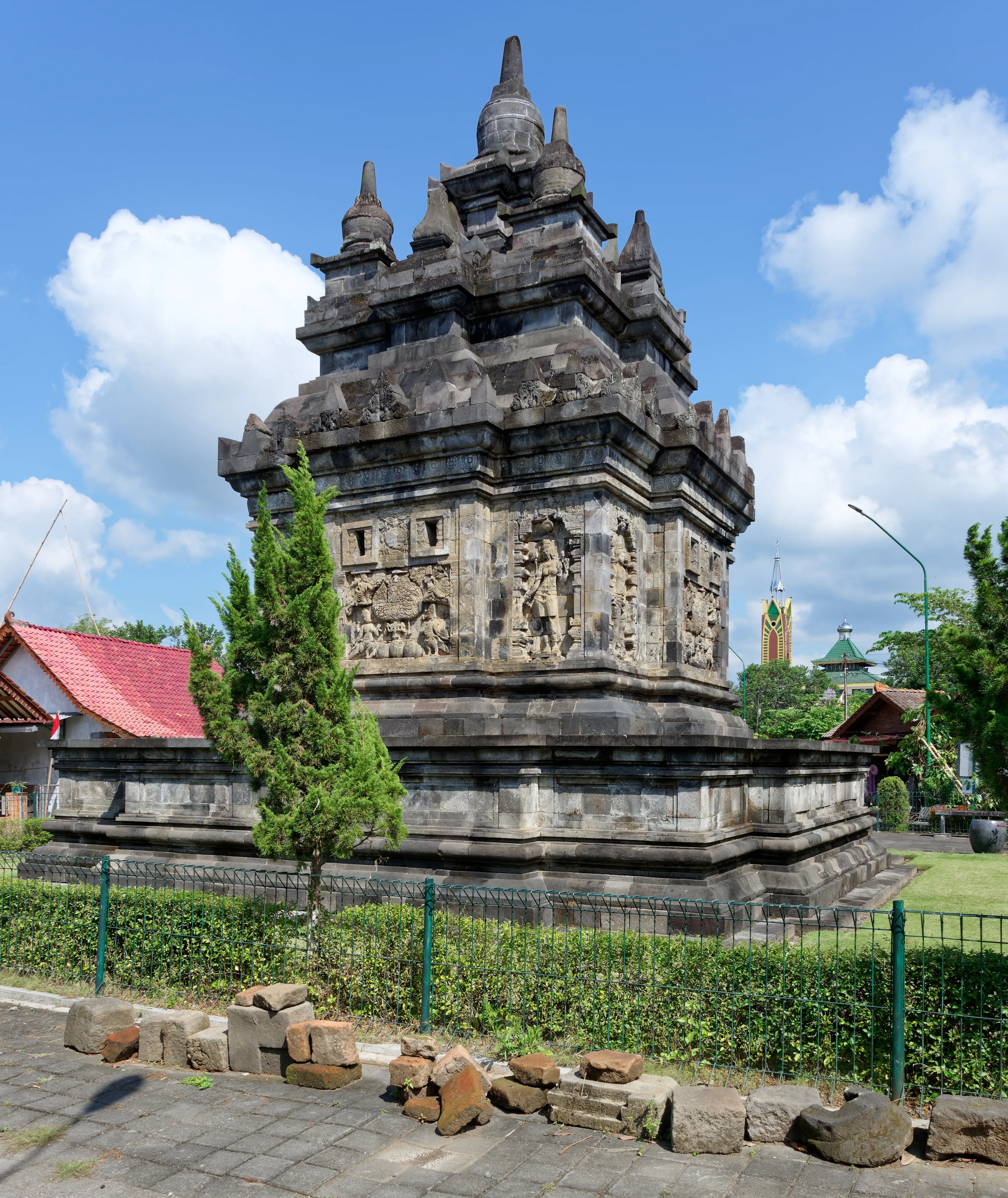
Pawon is one of the smaller monuments in the same heritage axis as Borobudur and Mendut.
Then Borobudur itself. Book a Structure Climb session in the morning rather than trying to squeeze it in at the end of the day. The climb is a steady circuit of steep volcanic-stone stairs in open sun with no shade at all, and the mandatory change into Upanat woven sandals at the base exists because visitor footwear was damaging the stone. Read the [Borobudur rules and etiquette guide](/guides/borobudur-temple-rules/) before you go so the prohibitions — tripods and selfie sticks on the structure, food in the inner compound, high heels — do not catch you out. If you would rather not climb, the grounds ticket is cheaper and the monument still rewards you at ground level.
Finish the day with a meal rather than another drive. If you want a local sweet, the [Getuk Magelang guide](/culinary/getuk-magelang/) explains what to ask about the difference between lindri, which is meant to be eaten immediately, and the coloured trio form that travels well.
## Day 2: Let the Weather Choose the Landscape
This is the flexible day, and it is deliberately placed second so that if the weather turns you can move it without losing anything you cannot get back.
**If conditions are clear and stable,** take Ketep Pass. It sits about 30 km north of Magelang city at roughly 1,200 m and gives you a view of Mount Merapi to the south and Mount Merbabu to the north. One correction worth making early, because it is a common error online: you view Merapi from around 30 km away. This is not a crater-rim visit and it is not a hike to an active crater edge. The volcano observation museum on site is the reliable draw on a hazy day. Check [MAGMA](https://magma.esdm.go.id/v1) for volcanic activity bulletins before you commit — volcanic risk and road-and-weather risk are two different problems, and only the second is likely to affect you.
A clear-day view from Ketep Pass; volcanic and weather guidance always comes before a fixed plan.
**If conditions are not right,** do not force Ketep. Punthuk Setumbu, about 3 km east of Borobudur at around 1,000 m in the Menoreh Hills, needs no ticket and gives you the Borobudur landscape at dawn — but dawn requires an early start and a narrow, steep, unlit road, and mist can be as much the point as the light. The [Punthuk Setumbu guide](/attractions/punthuk-setumbu-sunrise/) covers the road honestly.
**If the weather is genuinely bad,** swap this day with Day 1 and use the Wanurejo craft village near Borobudur, where the batik and rengginang workshops are indoors. See the [Wanurejo craft village guide](/attractions/borobudur-craft-village-wanurejo/) — it is the most reliable wet-weather plan in the region because the workshops do not depend on the sky.
Pick one main outdoor destination, not two. Bring layers, water, and footwear with grip, and agree your fallback before you leave the house in the morning.
## Day 3: A Living Landscape, Then a Good Meal
If weather and roads are suitable, spend the second half of the day at [Nepal Van Java in Dusun Butuh](/attractions/nepal-van-java-dusun-butuh/), a highland village in the Kaliangkrik area. Two things make it worth the drive. The first is the light: the terraced fields need late afternoon, raking side-light to read properly, so an early visit is the wrong visit. The second is that it is a living village, not a viewpoint — which means it rewards a different set of rules. Stay on open routes, ask before photographing people, homes, fields or work, and accept a no.
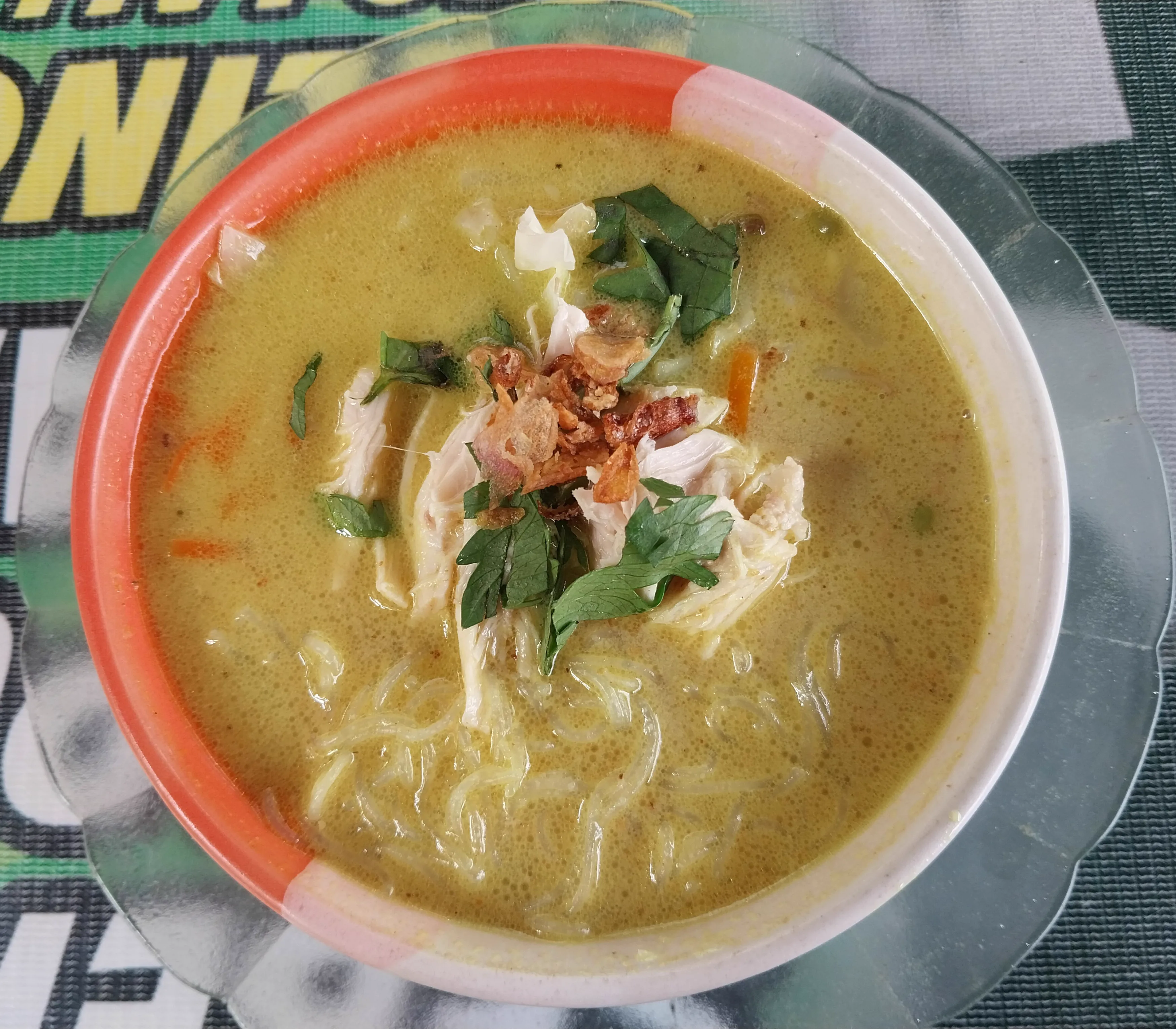
A local meal like Nasi Lesah makes a practical, weather-proof finish to the day.
For a food-focused finish, or if the roads have gone soft, stay in town and eat properly. Magelang is a good food town and you should not treat it as a gap between attractions. Start with [Soto Magelang and Nasi Lesah](/culinary/soto-magelang-nasi-lesah/) — the signature question in any Magelang warung is whether the broth is *santan* or *bening*, coconut milk or clear — and compare it with [Kupat Tahu Magelang](/culinary/kupat-tahu-magelang/). If you still have room, [Serabi and lumpur](/culinary/serabi-lumpur-magelang/) are the two griddle cakes worth crossing town for.
If you have a spare half day and want to be outdoors rather than in a queue, the other option is a dawn walk on [Mount Andong](/attractions/mount-andong-hike/), a four-summit hill north of the regency. It is a hill rather than a volcano, so it carries none of the hazard framing of the Merapi area, and the panorama from the top takes in Merapi, Merbabu, Sindoro and Sumbing. It needs a 1 to 3 am start, so it replaces an evening rather than filling one.
## Keep the Plan Adaptable
The best three-day plan is one you can change without stress. Avoid prepaying for more activities than your group can realistically enjoy. Keep one unstructured period each day for weather, meals, rest, or a conversation with your host.
Use the [sustainable travel guide](/guides/sustainable-travel/) throughout. The mechanics matter more than the intentions here: your entrance fee is conservation funding, the mandatory local guide on the Structure Climb is a real job created by your visit, and the daily climber limit exists to protect a monument that cannot be repaired if it wears out.
Two dates to plan around. During Vesak, thousands of monks and pilgrims process from Mendut to Borobudur and entry arrangements change substantially — if that is your reason for travelling, plan a different trip. And in the wet season, roughly November to March, expect this itinerary to run exactly as written but with Day 2 moved around; the [rainy season guide](/guides/magelang-rainy-season-guide/) works through the substitutions.
If three days is too much, the [two-day itinerary](/guides/magelang-two-day-itinerary/) drops Day 2 and keeps the heritage axis and the food. If you have a single day, the [one-day itinerary](/guides/magelang-one-day-itinerary/) works because the heritage axis fits comfortably inside it.