 Save
Save Key facts at a glance
- Era
- Late 8th century, Sailendra period
- Religion
- Buddhist (Mahayana)
- Distance
- 6 km east of Mendut, ~15 km from Borobudur
- Site size
- 3,556 m²
- Structures
- Five temples in the original compound
- Reconstructed
- One temple only
- Signature feature
- Rampant lion statues at the main temple's corners
- Name origin
- Old Javanese awi, meaning bamboo
Figures change without notice — treat this as a planning summary and confirm against the sources listed below.
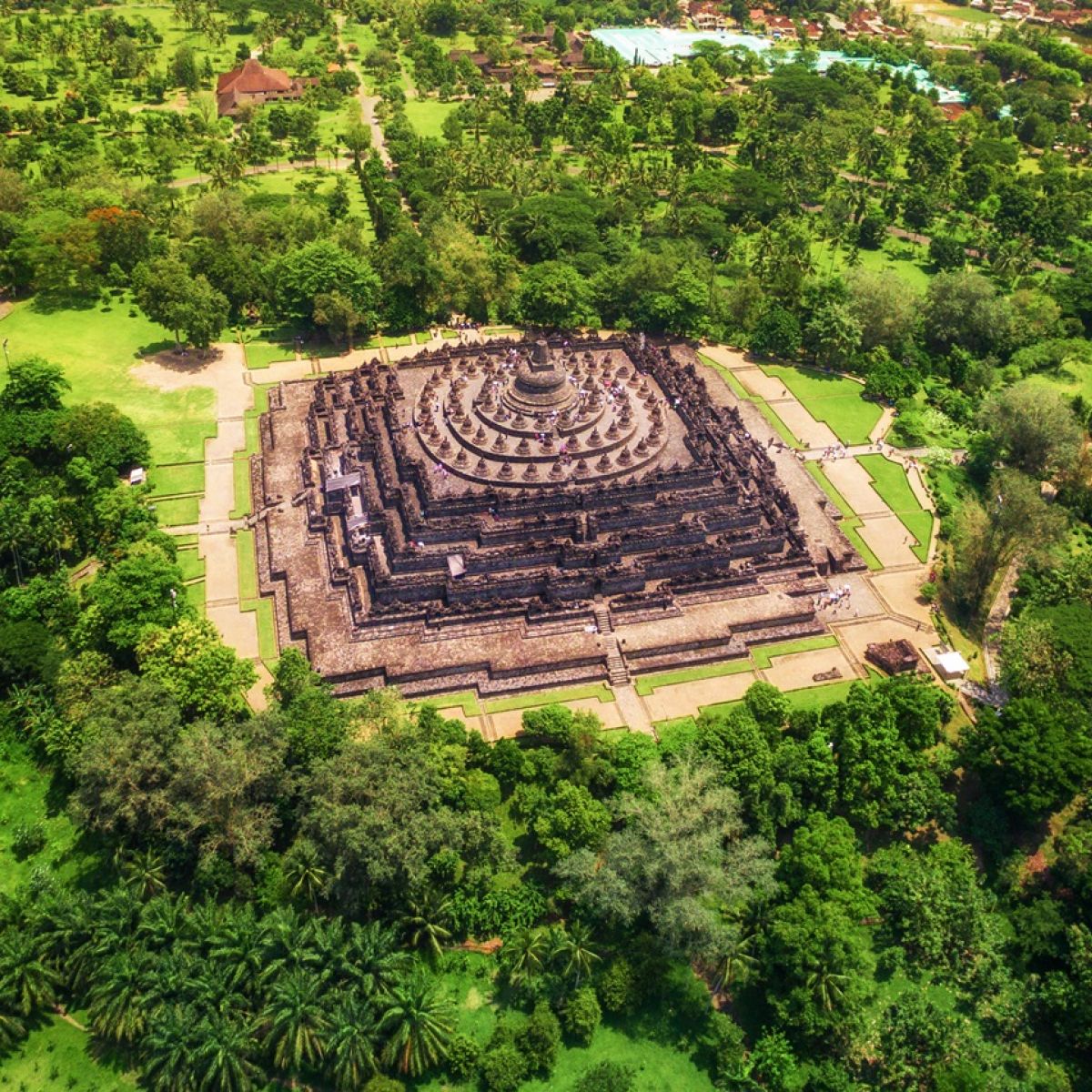
Borobudur gets the crowds. Ngawen — six kilometres east of Mendut, a short walk off the main road at Muntilan — gets almost none, and it is arguably the more interesting place to stand in. If you have already seen Borobudur and Mendut, this is the site that tells you what Central Javanese temples looked like before someone built something enormous.
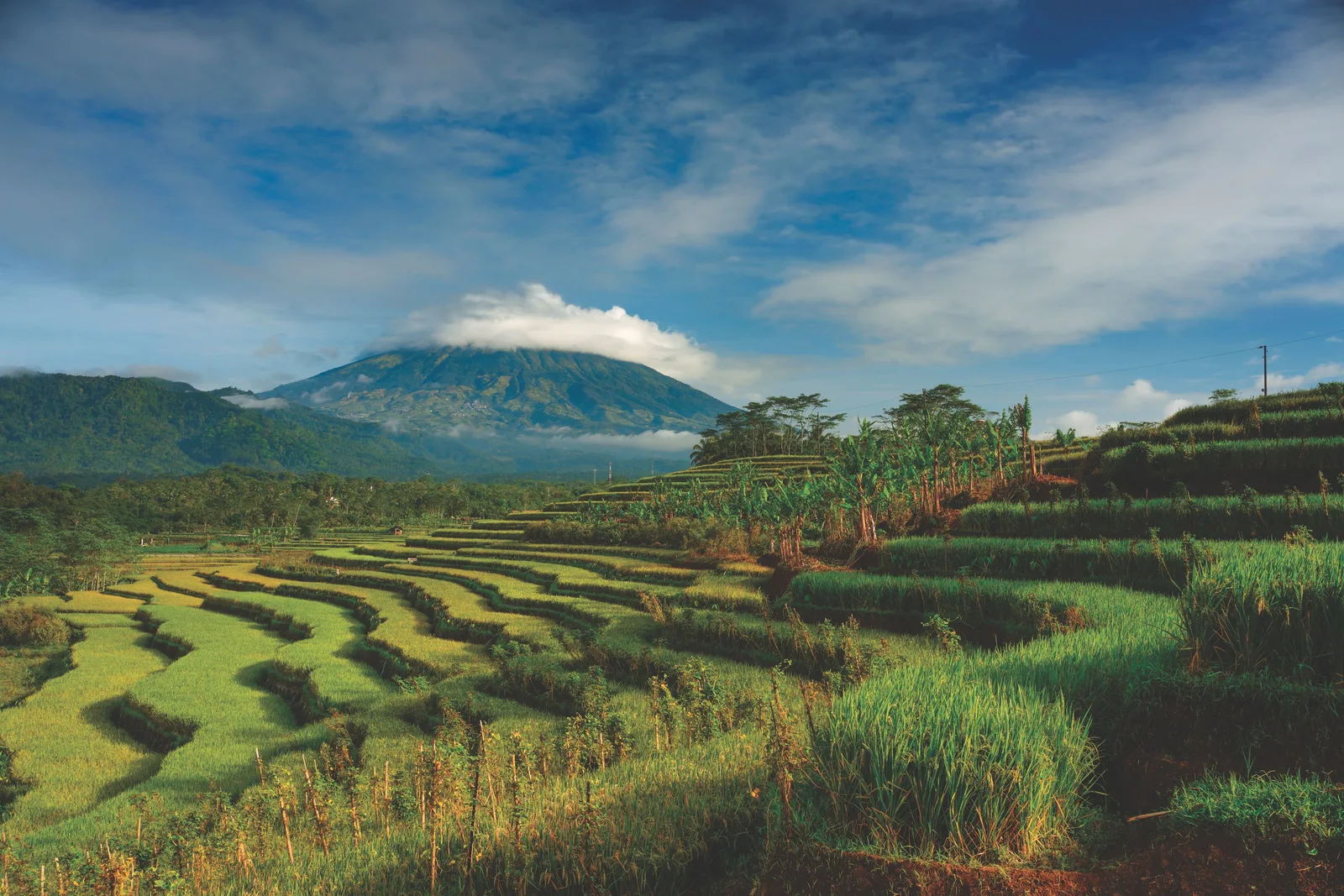
It is a small compound in a working village. A rice field is on one side. There are no crowds, no ticket hall, and no queue. What there is, is a set of andesite lions that will keep you there longer than the forty minutes you planned to spend.
Why the lions matter
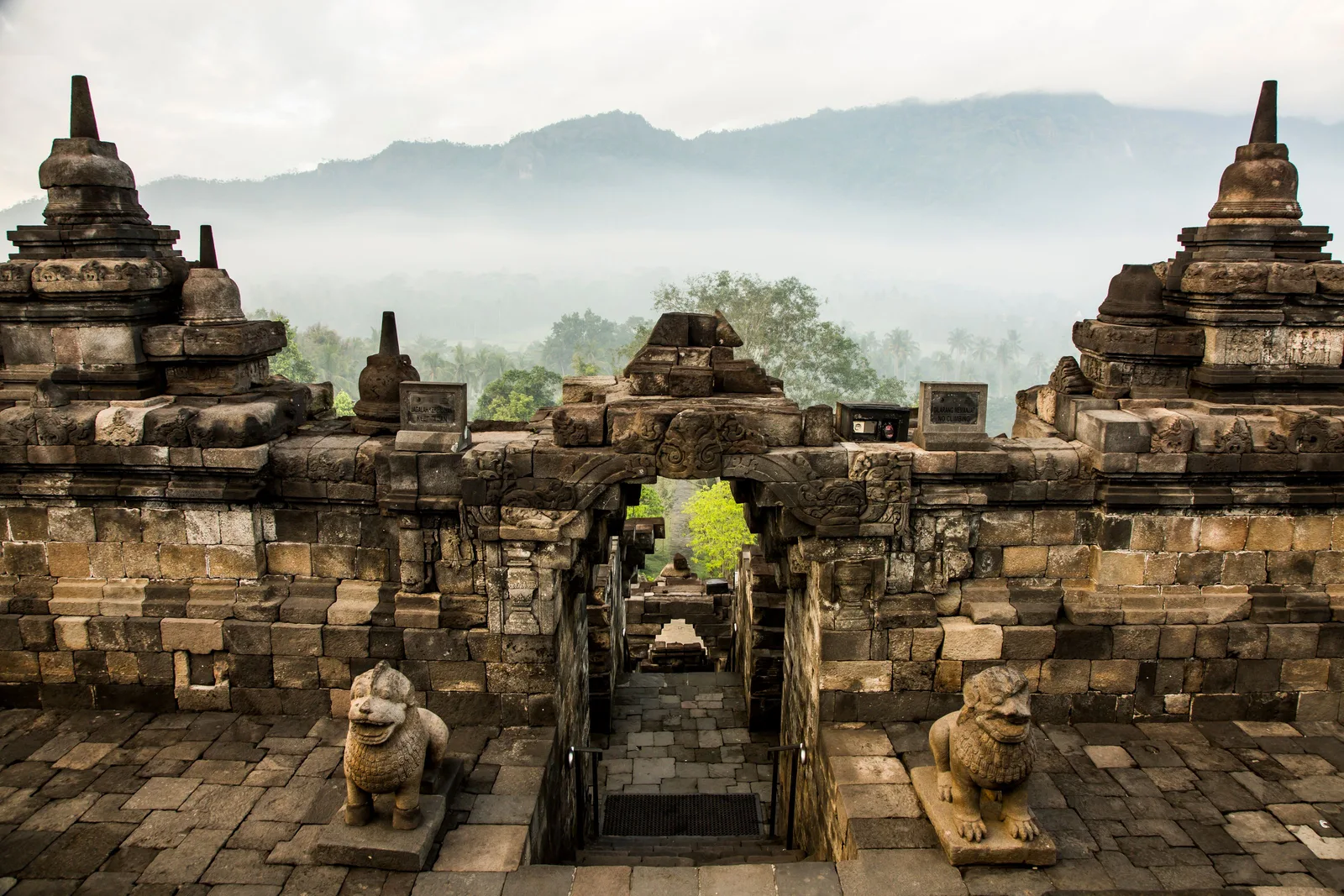
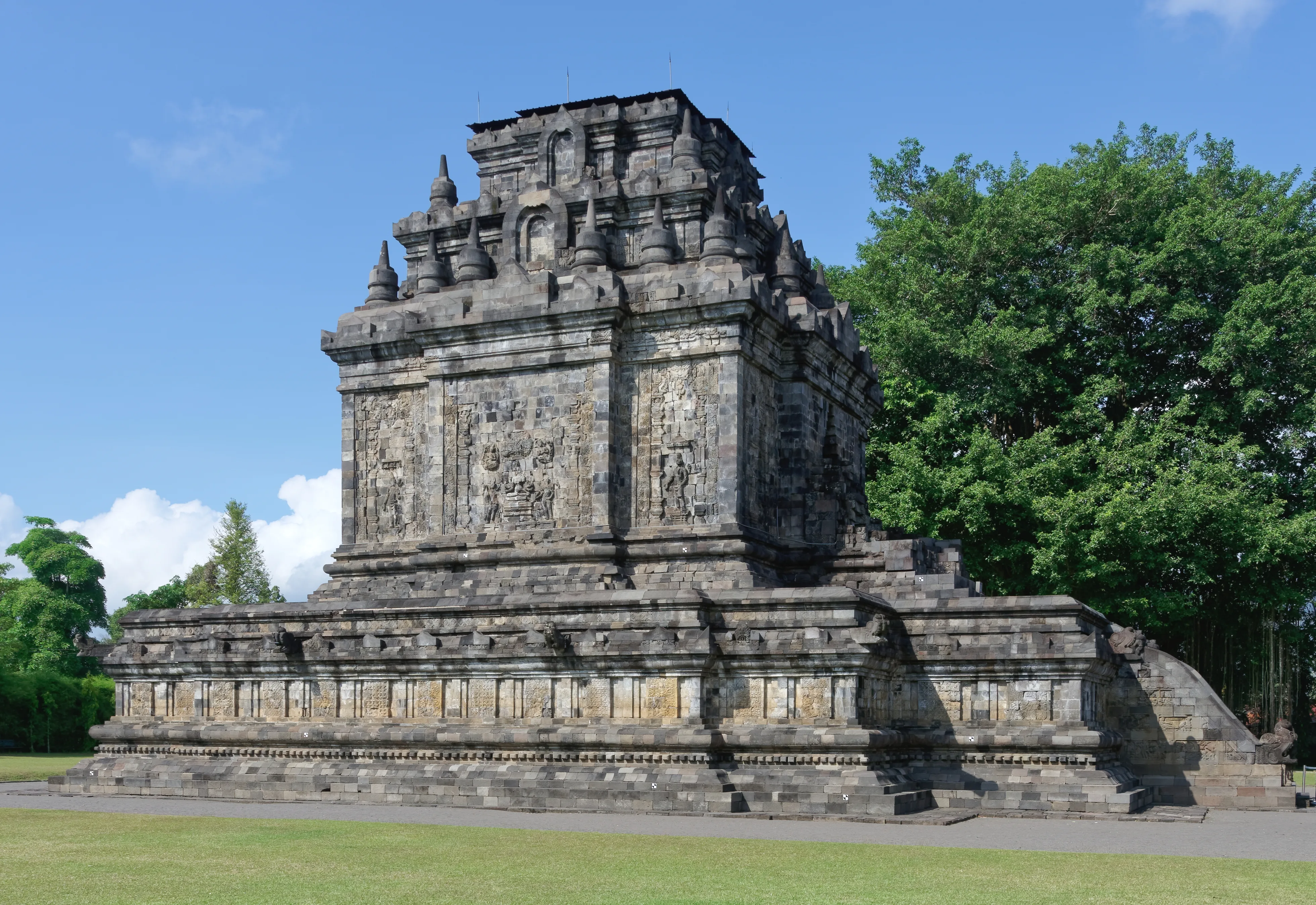
The main temple at Ngawen carries rampant lion statues at each of its corners. Across the wider tradition of Central Java candi, this is unusual — lions are not a motif you expect to find repeated around a Javanese temple base, and the Ngawen examples are described as quite unique among their peers.
Rampant means rearing. These are not decorative animals sitting calmly at attention. They are up on their hind legs, in the posture that says something is being guarded.
The other motif to look for is on the base walls: kinnaras, half-bird half-human figures drawn from Buddhist cosmology. They are subtle at first. Walk the base slowly and they resolve out of the stone.
Kinnaras are worth pausing on, because they are one of the clearest traces of a belief system rather than a decorative one. In Buddhist cosmology a kinnara is a being of celestial music — part bird, part human, permanently in the air above the human world. Finding them carved around the base of a village temple means the builders were populating the threshold with beings from the heavenly realm, marking the transition between ordinary ground and sacred enclosure. You will see them at Mendut and Pawon too, which is part of the evidence that these three sites were built within a shared visual language.
The stairs are on the east side of the temple. That is unusual enough to trip people up — most visitors circle to the western approach first and have to come back around.
The Mendut Connection, in Detail
The name footnote is worth expanding, because the bamboo thread runs through several of these sites and it is genuinely interesting when handled carefully.
Ngawen is generally placed in the late 8th century, which puts it slightly earlier than Borobudur and close to Mendut. The artistic style and iconography sit firmly in the Sailendra-era Central Javanese idiom, and most researchers connect Ngawen to the same religious and political world that produced Mendut, Pawon and Borobudur.
The original name of the Ngawen temple is uncertain, but “Ngawen” is generally derived from Old Javanese awi, meaning bamboo. Ngawen village is full of it.
Now the part that is tempting and must be labelled correctly. The Karangtengah inscription, dated 824 AD, records that King Indra of the Shailendra dynasty completed a sacred building called Venuvana — literally “bamboo forest”. The Dutch archaeologist J. G. de Casparis connected that name to Mendut. Given that Mendut, Pawon, Borobudur and Ngawen are all Sailendra-era sites in the same plain, and that Venuvana translates to something as common in this landscape as “bamboo forest”, there is an obvious temptation to extend the connection to Ngawen too.
That step is speculation rather than established fact, and it is worth saying so, because the difference matters. Venuvana is a documented identification attached to a documented inscription. “Ngawen comes from awi” is a plausible etymological derivation of a modern place name. Linking them is a reasonable inference and not a documented one. The Mendut guide covers the inscription in full.
What is not speculative is that all of these temples were built within a few decades of each other by the same political tradition, in a landscape where bamboo was a defining feature of the villages that supported them. The name is a footnote; the clustering is the story.
Five temples, one standing
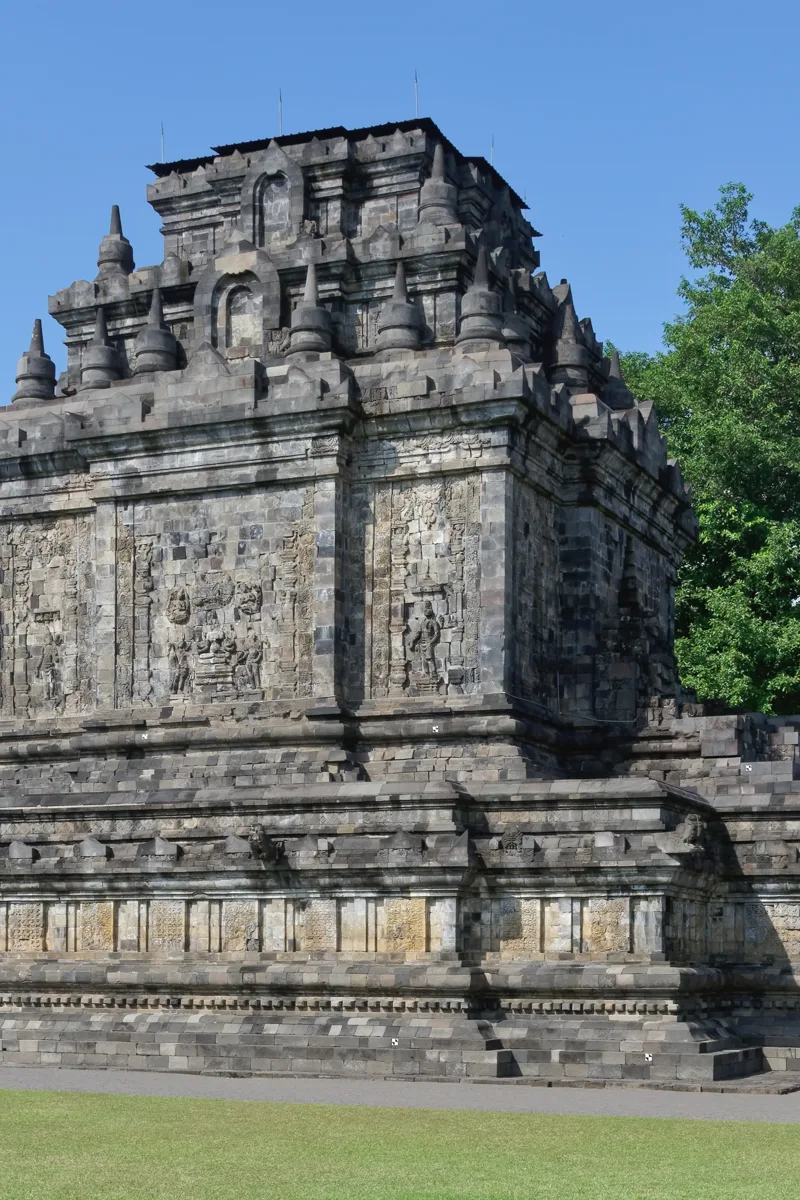
This is the detail that changes how you visit. The original complex contained five temples. Only one has been successfully reconstructed. The rest survive as base stones and fragments scattered through the grass.
If you arrive expecting a miniature Borobudur, you will be disappointed. If you arrive expecting an archaeological site where a village has grown up around and through the remains of something eight centuries old, you will be exactly where you should be. Mendut and Pawon have the same story — Mendut was found in 1836 as a ruin overgrown with bushes — but at Ngawen the fragments are still visible in their original positions, which makes the plan of the compound readable.
That readability is the argument for the site. Borobudur’s plan is legible because it is intact and enormous; Mendut’s is legible because one building is beautifully complete; Ngawen’s is legible because five foundations are still in situ. You can see the plan of a temple complex without a single complete building, which is an unusual and rather moving thing to stand in.
There is also a physical reason less survives here, and it explains the whole Central Javanese pattern. Ngawen was found in a settled village rather than under volcanic sediment, so it was never buried and protected the way Borobudur was. Where a site is unburied it erodes, gets cleared for farmland, has its stones reused, and is robbed of loose sculpture. Borobudur survived because ash covered it; Ngawen survived as much as it did because it sat in a village that kept some of it in place.
The compound as a whole measures about 3,556 square metres, which is a useful correction to the scale most people carry from Borobudur. It is a village-scale religious site, not a monument.
Restoration here ran in the early 20th century, in the same broad period as the work at Mendut and Pawon.
Getting there and fitting it in
Ngawen village sits on the main road heading south from Muntilan toward Yogyakarta, roughly 15 km from Borobudur and 6 km east of Mendut. That last fact is the planning tool: Ngawen and Mendut make a natural pair.
Muntilan is on the Magelang–Yogyakarta bus route, so Ngawen is reachable without a car — from Muntilan town it is a short local ride out to the village. With a driver it is an easy add-on to a Mendut morning.
Budget forty to sixty minutes. That is the honest figure for the compound itself. It is not a Borobudur-scale visit and there is no café, no museum, and no viewpoint to fill the time.
Two practical notes that make the visit easier. There is shade — the compound sits among village trees, which on the Kedu Plain is not guaranteed and here is a genuine advantage in the middle of the day. And there is no need for the prep you do at Borobudur: no wristband, no shoe change, no restricted bag, no mandatory guide, no ticket hall. The Borobudur ticket and Structure Climb guide covers the main monument’s separate admission and booking rules, because Ngawen is not included in that ticket and the confusion causes real problems at the gate. The Mendut guide is the closest companion piece, since the two sites share an era and sit six kilometres apart.
Because it is a working village rather than a ticketed monument, ordinary village etiquette applies. The sustainable travel guide covers how to behave at places like this — and the short version is that a village temple is a religious building first and an archaeological site second.
Nearby, if you have the time
The Kedu Plain is dense with small temples, and two more are within a short drive. Candi Gunung Wukir near Salam carries Indonesia’s earliest dated inscription and is a genuinely different kind of story — a political and chronological one rather than an artistic one. Candi Selogriyo, north of the city on the Sumbing slopes, is an 8th-century Hindu temple whose four corner deities are carved in relief rather than modelled.
Both are quiet, both are inexpensive, and both reward the kind of unhurried attention that Ngawen rewards. The sustainable travel guide covers how to sequence these low-impact, low-crowd visits.
Sustainable Tip
Ngawen is small enough that the whole compound fits in about forty minutes. Do not climb the reconstructed temple's base or push past the roped-off areas to get a better photo — the andesite is original and the erosion damage to these temples is irreversible.
Family Tip
This is the easiest genuine 8th-century temple in the region for children, because the compound is flat, open, and shaded by village trees. The lions are the hook: point them out before you arrive and most children will be looking for them rather than asking how long the visit is.
Frequently asked questions
Is Candi Ngawen included in the Borobudur ticket?
No. Ngawen is a separate site with its own local admission, and it is not part of the UNESCO-listed Borobudur Temple Compounds ticket that the state operator sells. That is also why it costs a fraction of the Borobudur price. Expect to pay a small local cash fee at the entrance.
Why is only one of the five temples standing?
Of the five original temples, only one has been successfully reconstructed. The others survive as scattered base stones and fragments, which is normal for Central Java sites that were never buried under volcanic sediment the way Borobudur was. Ngawen was found in a settled village rather than under ash, which is the main reason less of it survives.
Are the lion statues real or restored?
The corner lions are the site's defining feature and are described as quite unique among Central Java candi. Treat them as original fabric with conservation work rather than modern reconstructions, and look at them rather than touching them — they sit low enough at the base corners that visitors naturally reach for them.
How long should I allow for Ngawen?
Forty to sixty minutes is realistic for the whole compound, more if you stop at the village stalls. It is not a half-day site the way Borobudur is. Pair it with Mendut, which is six kilometres west, if you are already in the area.
Do I need a guide at Ngawen?
There is no formal guide requirement comparable to Borobudur's mandatory Structure Climb guide. Local attendants are usually present. The interpretative material is thin, so it is worth knowing the basics before you go — the lions, the kinnaras on the base walls, and the east-side stairs are the three things worth looking for.
How do I get there without a car?
Ngawen village sits on the main road south of Muntilan, roughly 15 km from Borobudur. Muntilan is on the Magelang–Yogyakarta bus route, and local angkot or ojok run between Muntilan and the villages around it. From Borobudur it is a short local ride rather than a day trip.
Tourism information — including opening hours, entrance fees, and transport routes — may change. Please verify with official local sources before planning your visit.
Sources and further checks
Use these primary or specialist sources to confirm current access rules, safety notices, and travel arrangements.

About the Author
Larasati Wulandari
Independent travel writer · Central Java, Indonesia
Larasati Wulandari is an independent travel writer who has lived in Central Java for eight years. She writes first-hand, practical guides to Magelang's temples, viewpoints, and local food, and reviews them regularly as conditions change.