 Save
Save Key facts at a glance
- Dated
- 732 AD (654 Saka)
- Religion
- Hindu, Shaivite
- Attributed to
- King Sanjaya, first ruler of Ancient Mataram
- Suspected original name
- Shiwalingga in Kunjarakunja
- Temples in the complex
- Main temple plus three perwara shrines
- Hill climb
- About 300 m on foot from the hamlet
- Near
- 3 km from the Kali Krasak bridge, Central Java–Yogyakarta border
- Building material
- Andesite
Figures change without notice — treat this as a planning summary and confirm against the sources listed below.
Every other temple in this guide is dated by style, by comparison to other sites, or not at all. Candi Gunung Wukir — Canggal — is different. It carries a year.
The Prasasti Canggal was found in the temple’s ruins in 1879 and names 732 AD (654 Saka), attributing the foundation to King Sanjaya, the founder and first ruler of Ancient Mataram. It is the earliest surviving historical record in Indonesia that states a year of manufacture, and it now sits in the National Museum of Indonesia in Jakarta. That single stone is why this site matters more than its appearance suggests.
Standing in the remains of a temple roughly a century older than Borobudur, on the same plain, built by the political tradition that later funded the great monuments — that is a genuinely different experience from visiting a well-preserved ruin. This one is mostly fragments.
Why a Number Changes Everything
It is worth being clear about how much weight a single date carries, because the reason is not obvious until you look at what the alternative is.
Almost every early temple in Java is dated by comparison. Scholars place Candi Sari, Mendut, Pawon and Borobudur relative to each other on stylistic grounds — this relief type appears first here, that brick form is used at that period — and the resulting dates carry margins of decades. Those margins are wide enough that arguments run for generations about which monument preceded which.
An inscription that states a year removes the argument at that point. Canggal can be placed on a timeline absolutely, and everything related to it inherits some of that certainty. This is why the Prasasti Canggal is described as the earliest surviving Indonesian historical record that states a year: not the oldest document, but the oldest one with a fixed point in it.
It also explains why the temple itself is treated as more important than its condition suggests. A well-preserved temple of unknown date is interesting; a fragmentary temple with a firm date is a reference point. The inscription is the artefact. The ruins are the context.
What Is Actually There
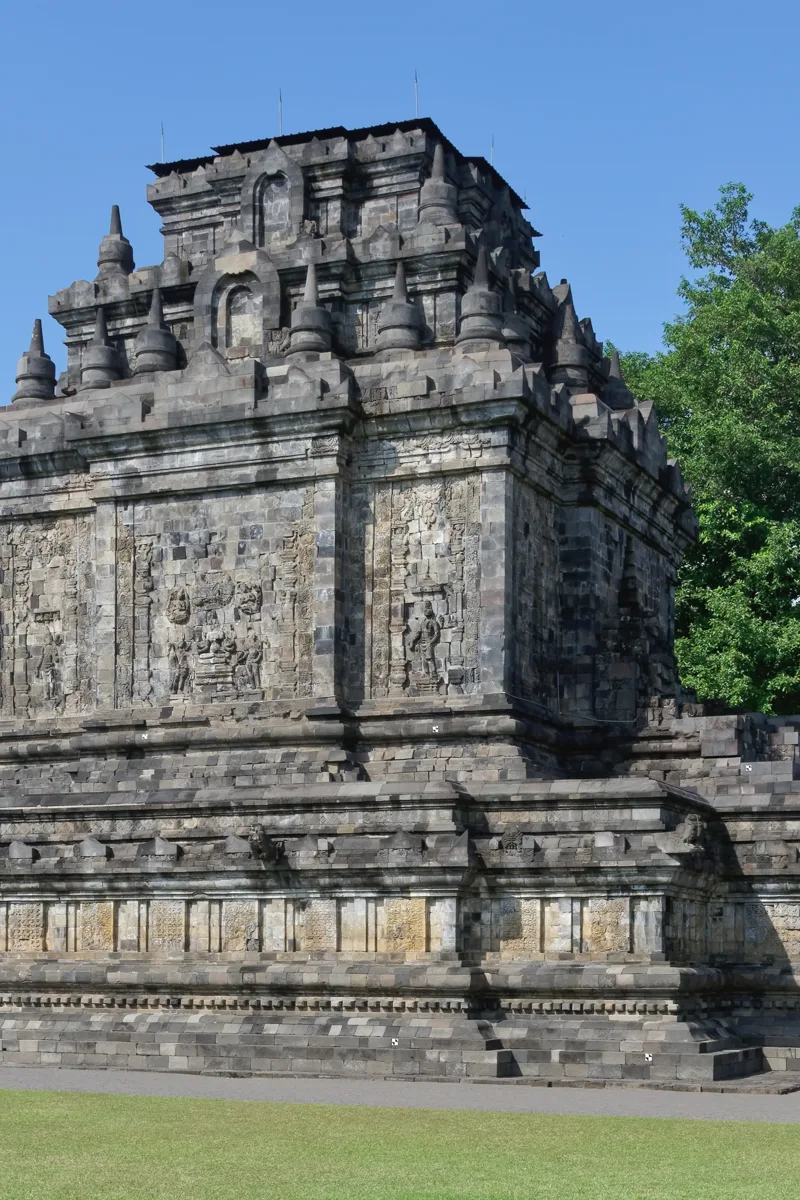
The temple is a Shaivite Hindu structure, not Buddhist. That identification comes from finds on site including a Nandi bull statue and a yoni — the Nandi being the bull mount of Shiva, and the yoni the characteristic Shaivite emblem. Neither would appear at Mendut or Borobudur, and together they settle the question in a way that stylistic argument could not.
This matters for the wider picture. It means both major religious traditions were building in the same plain in the same period, and that the boundary between them was porous rather than clean.
The complex once contained four temples: one main shrine and three perwara, the attendant shrines that stood in front of it. Understanding perwara is the single most useful thing you can bring to this site — these were not separate deities or separate monuments but subordinate structures belonging to the main temple, and their presence tells you the original complex had a designed plan and an axis. The perwara have since been identified separately from the main remains.
The stonework is andesite and no longer intact. What you are walking over are partial remains and scattered blocks rather than standing architecture. Because andesite is the same volcanic stone used across central Javanese candi including Borobudur, fragments here are recognisably the same material — which is a good way to make the connection between a ruin and a monument concrete.
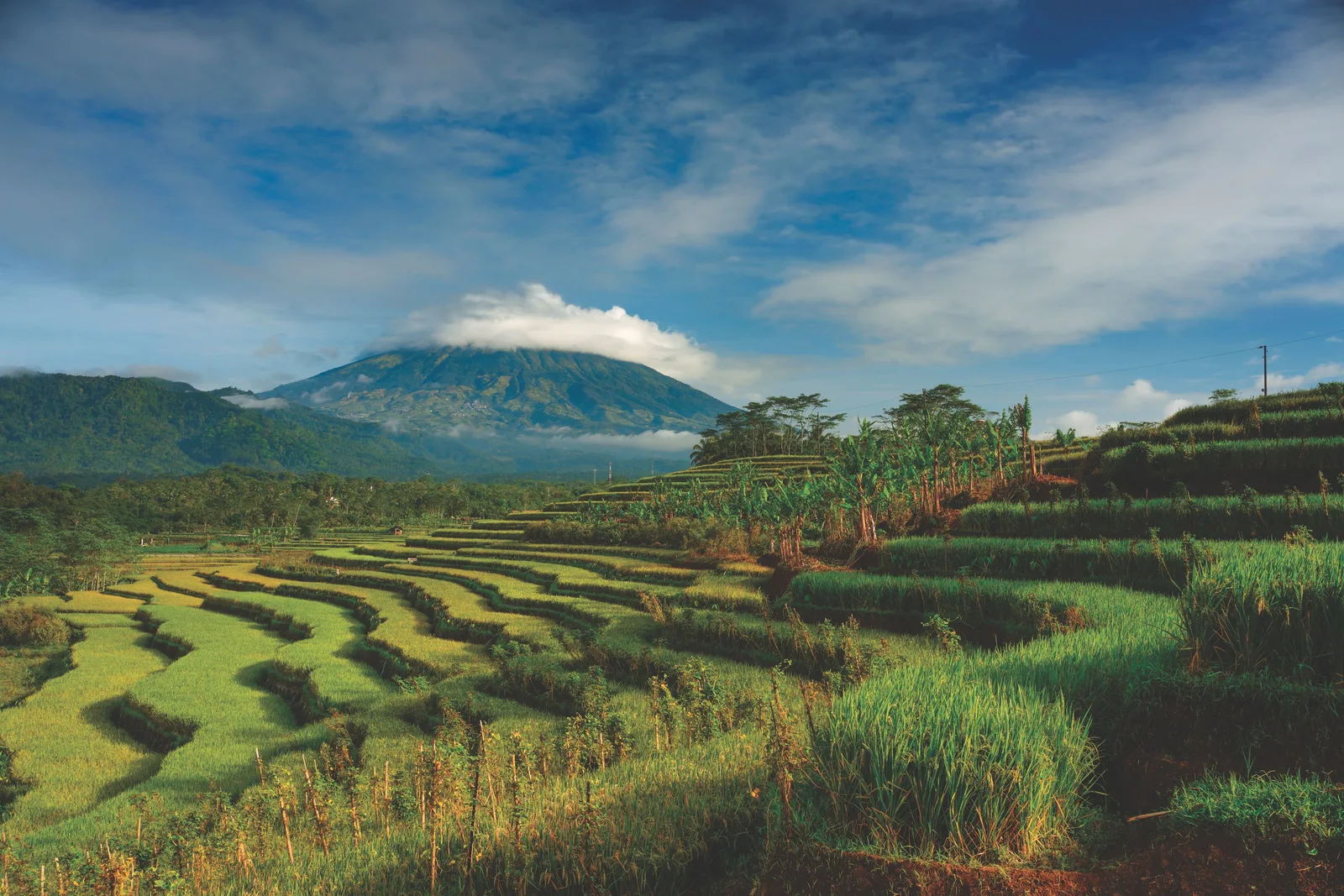
The name deserves a footnote. “Gunung Wukir” means hill of Wukir — and wukir in Javanese already means hill or mountain, so the name is mildly redundant, a doubled word that survived from the period when the site was called after the small hill it stands on. The temple’s suspected original name is Shiwalingga in Kunjarakunja, which fits a Shaivite foundation nicely, though this is inference from the inscription rather than a certainty.
Getting There
Wukir sits on Bukit Wukir, a small hill in the Kedu Plain, in Canggal hamlet, Kadiluwih village, Salam sub-district of Magelang Regency. It lies about 3 km from the Kali Krasak bridge on the Semarang–Yogyakarta national road, which is also the boundary between Central Java and Yogyakarta — useful as a landmark, because the bridge is on the main north–south artery and therefore easy to navigate to.
Reaching the temple means walking uphill roughly 300 metres from the nearest hamlet, near the road connecting Salam and Ngluwar. Budget ten minutes at an easy pace. The path is uneven with steps in places, so bring shoes with grip and water.
Being a small lowland site rather than a viewpoint, Wukir suits a different part of a trip from Ketep Pass or Punthuk Setumbu. Those need conditions and clear weather. This one works in ordinary weather, which makes it a useful counterweight — see the rainy season guide for how to use lowland, low-elevation sites when the highland plans fall through.
The Wider Salam Cluster
Wukir is not isolated, and that is its best argument for a half-day. Several same-period finds sit nearby:
- Candi Losari — discovered in 2004
- Petirtaan Mantingan — a bathing site discovered in 2019
- Candi Gunungsari and Candi Ngawen — somewhat further northwest
With the exception of Ngawen, all of these are within Salam sub-district. That density is the point: the Kedu Plain was not a landscape with one famous temple on it. It was a landscape made of temples, and Wukir happens to be the one with a date on it.
Candi Selogriyo is the other strong pairing — also 8th century, also Hindu, also quiet, and on the opposite side of the regency toward the Sumbing slopes. Candi Ngawen is the Buddhist counterpoint, 15 km away, and notable for the rampant lion statues at the corners of its main temple. Together the three cover both religious traditions of the period at a fraction of the crowds Borobudur draws.
Practical Notes
Admission at small regency temples like this is a local cash fee, not a ticketed attraction — orders of magnitude less than the Borobudur Structure ticket, which the Borobudur tickets and Structure Climb guide covers in detail. Bring small notes; nobody at a site this size is equipped to take a card.
There is little or no interpretative signage, and no shade on the hill. Knowing the three things worth looking for — the 732 date, the perwara layout, and the Shaivite Nandi and yoni finds — is the difference between walking past rubble and understanding what it was.
The best time to visit guide covers when to pair lowland sites like this with the highland viewpoints, and the 2-day itinerary sequences this with Mendut and Borobudur if you are building a short trip. For a longer build, the 3-day itinerary treats this as a serious alternative heritage day rather than an add-on.
Sustainable Tip
The climb is short but exposed, and the stone here is fragmentary — resist stepping onto the surviving base courses to get an angle for a photo. Wukir has no visitor pressure at all, which means there is no justification whatsoever for damage in exchange for a slightly better shot.
Family Tip
The 732 date is the hook for older children: this is a temple that can be placed on a timeline, roughly a century before Borobudur and in the same century as Candi Sari near Yogyakarta. The walk up takes about ten minutes and is the physical part of the visit.
Frequently asked questions
Why is Candi Gunung Wukir more important than Borobudur?
Not aesthetically — it is a ruin, while Borobudur is a monument. Wukir matters chronologically. The Prasasti Canggal, found in its ruins in 1879, carries a year of construction, 732 AD, which makes this the earliest temple in Indonesia that can be tied to a firm date. Borobudur cannot be dated that precisely from an inscription.
What is the Prasasti Canggal and why does it matter?
It is an inscription naming King Sanjaya as founder and dated 732 AD, now held in the National Museum of Indonesia in Jakarta. It is the earliest surviving historical record in Indonesia that states a year, which makes it a reference point for dating everything else in the country. Most of the temple stonework around you is less well preserved than the record of it.
Is Candi Gunung Wukir Shaivite or Buddhist?
Hindu, specifically Shaivite — dedicated to Shiva rather than to a Buddha. The identification rests on finds at the site including a Nandi bull statue and a yoni, both unmistakably Shaivite elements. This distinguishes it from Mendut, Pawon and Borobudur, which are Buddhist.
How much of the temple is left?
Fragmentary. The andesite structures are no longer intact, and what survives is a set of partial remains. Three of the four original temples were perwara — attendant shrines in front of the main temple. Visit it for the position it holds in the timeline, not for preserved architecture.
How difficult is the walk up?
About 300 metres of uphill walk from the hamlet, taking roughly ten minutes at an easy pace. The surface is uneven and there are steps. Wear shoes with grip and take water. It is not a serious climb, but it is not a level path either.
Can I combine Wukir with other temples?
Yes, and it is worth doing. Candi Selogriyo is another 8th-century Hindu temple in the regency, and Candi Ngawen is an 8th-century Buddhist compound. The Salam, Ngluwar and Windusari sites together make a coherent loop about the Sumbing slopes and the edge of the Kedu Plain.
Tourism information — including opening hours, entrance fees, and transport routes — may change. Please verify with official local sources before planning your visit.
Sources and further checks
Use these primary or specialist sources to confirm current access rules, safety notices, and travel arrangements.

About the Author
Larasati Wulandari
Independent travel writer · Central Java, Indonesia
Larasati Wulandari is an independent travel writer who has lived in Central Java for eight years. She writes first-hand, practical guides to Magelang's temples, viewpoints, and local food, and reviews them regularly as conditions change.