 Save
Key facts at a glance
- Date
- 9th century; carving detail suggests slightly older than Borobudur
- Position
- Between Mendut and Borobudur on one straight axis, about 2.9 km end to end
- Village
- Brojonalan, Borobudur district; about 1.5 km east of Borobudur
- The name
- Pawon means kitchen in Javanese; locally also called Bajranalan
- The open question
- Its chamber is empty and does not identify the deity worshipped there
- The key object
- A single square basin stands at the centre of the empty chamber
- Heritage status
- Listed with Mendut and Borobudur by UNESCO in 1991
- Typical visit
- Fifteen to thirty minutes, treated as a stop on the axis
Figures change without notice — treat this as a planning summary and confirm against the sources listed below.
Pawon is the smallest of the three Borobudur temples and the most frequently misunderstood, partly because the most commonly repeated fact about it is wrong. It is not a minor version of Borobudur, and it does not sit at the exact midpoint of the axis. It is a small building with a specific and still-contested job, and its most striking feature is a single stone basin standing in an otherwise empty room.
First, a correction about the midpoint
Plenty of travel writing, including older versions of this guide, describes Pawon as sitting at the exact midpoint of the Mendut–Pawon–Borobudur line. The distances do not support that.
The total run from Mendut to Borobudur is about 2.9 km, which everyone agrees on. What sources disagree about is which of the two gaps is the longer one. Lokesh Chandra, whose reading is repeated widely, gives 1,150 m from Mendut to Pawon and 1,750 m from Pawon to Borobudur — a ratio of about 1.5 to 1. The encyclopedia infobox gives the same two figures with the labels reversed, putting Mendut 1.75 km to the northeast and Borobudur 1.15 km to the southwest.
Under the first reading, Pawon sits about 40% of the way along the line. Under the second, about 60%. Either way it is roughly 300 m off the true halfway point of 1,450 m.
This does not matter much, and we are not going to pretend it does. What it does tell you is that the axis was laid out by people who had a scheme in mind, and that the scheme is not “put the small one in the middle.” It also means that if a guide tells you the distances with total confidence, it has picked one source and hidden the disagreement. Lonely Planet’s description, “around 1.5 km east of Borobudur”, sits in the middle of every measurement and is probably the safest figure to plan with.
The name is the puzzle
Pawon is not simply a label the locals attached. The name is the oldest surviving clue about the building, and it points at least four different directions. None of these readings has won.
Pawon means kitchen in Javanese. The word is usually traced to a root meaning dust, which produces a derivation meaning roughly a place that contains dust — a temple holding the ashes of a cremated person. On that reading Pawon is a mortuary temple, and the Dutch archaeologist J. G. de Casparis connected it to a shrine preserving the remains of King Indra, who ruled from 782 to 812 AD and was the father of King Samarrattungga of the Shailendra dynasty. Nobody has identified a grave.
Locally it is also called Bajranalan, from Sanskrit words for thunderbolt and fire, together forming the flaming thunderbolt — a weapon of King Indra. On this reading the temple is a shrine housing the weapon rather than the king, and Lokesh Chandra proposed it was a fire-offering temple whose presiding deity was Acala. The identification of the two words is clean and appealing, which is exactly why it should be treated as a proposal.
Britannica describes it as dedicated to the god of wealth, and calls it probably a kind of anteroom to Borobudur catering to the more worldly interests of pilgrims. That is a different job again: a place for the mercantile side of a religious experience rather than its contemplative one.
Yazir Marzuki and Toeti Heraty called Pawon the jewel of Javanese temple architecture and suggested it most probably served to purify the mind before ascending Borobudur. This is the reading most visitors are implicitly shown, and it is the one this guide leans on when describing what to look for — with the caveat that leaning on it is a choice, not a finding.
Chandra went further and mapped the three temples onto three different realms of Buddhist tantric thought, placing Pawon and Mendut in one category and Borobudur in another. The anthropologist Purbatjaraka argued instead that Pawon was an upa angga, an integral part of Borobudur rather than a separate building at all.
Set side by side, these readings are not variations on a theme. They are mortuary, devotional, transitional, and administrative. A guide that picks one and states it flatly is telling you something about the guide, not about the temple.
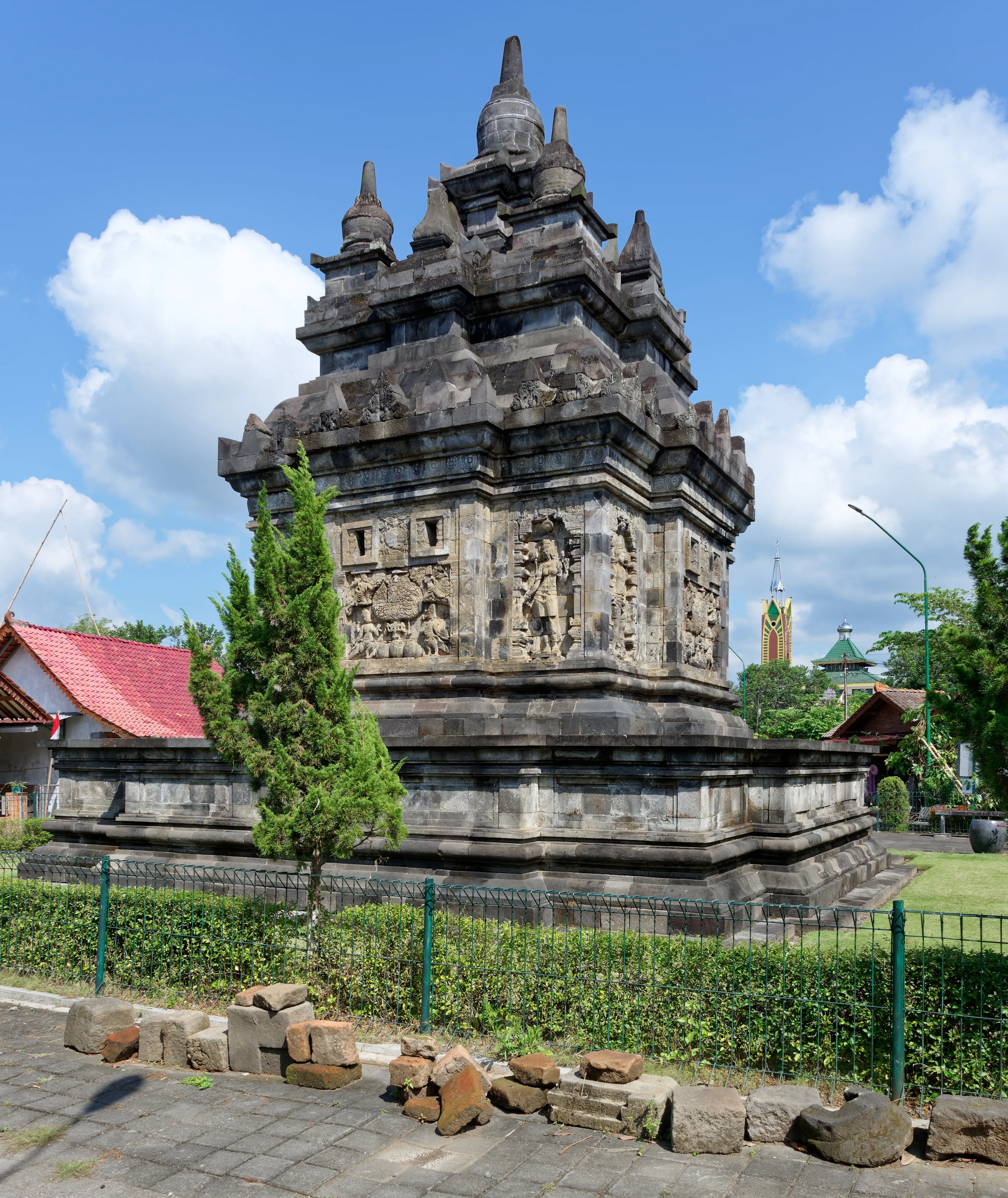
The object in the empty room
This is what makes Pawon worth fifteen minutes, and it is a single object.
The inner chamber is a square room with a square basin set into the centre of it. There is no main statue. UNESCO notes that the inner space does not identify the deity that may have been worshipped here, and that absence of an identifying figure is a genuine gap in the record, not a gap in the signage.
Look at the basin and notice how much it constrains the possible answers. Water held in a cut stone basin in a purpose-built stone chamber is exactly what you would expect in a place for ritual washing — which is why the purification-pavilion reading is the most popular, and why it fits so neatly with Pawon’s position partway along the route to the main monument. The same object is also exactly what you would expect in a kitchen, which is the one thing the name actually says.
That is the honest state of it. One object, two readings, both physically plausible, no inscription to settle it. A small rectangular window on each side, probably for ventilation, admits light without solving anything.
What is actually carved here
Pawon has no narrative relief programme, so it is not going to give you the hours that Borobudur does. What it has is a density of small, high-quality carving, and it is worth slowing down for.
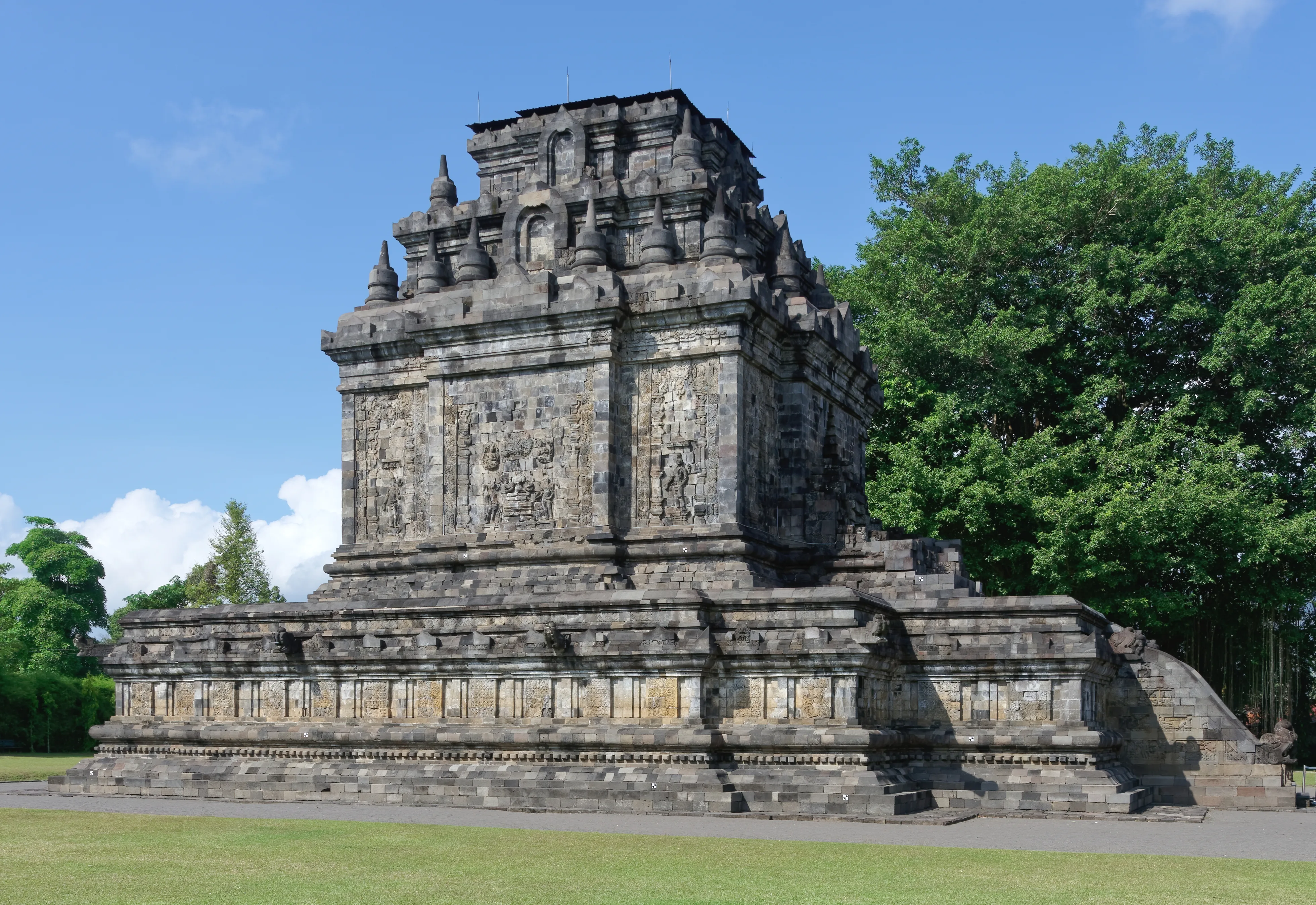
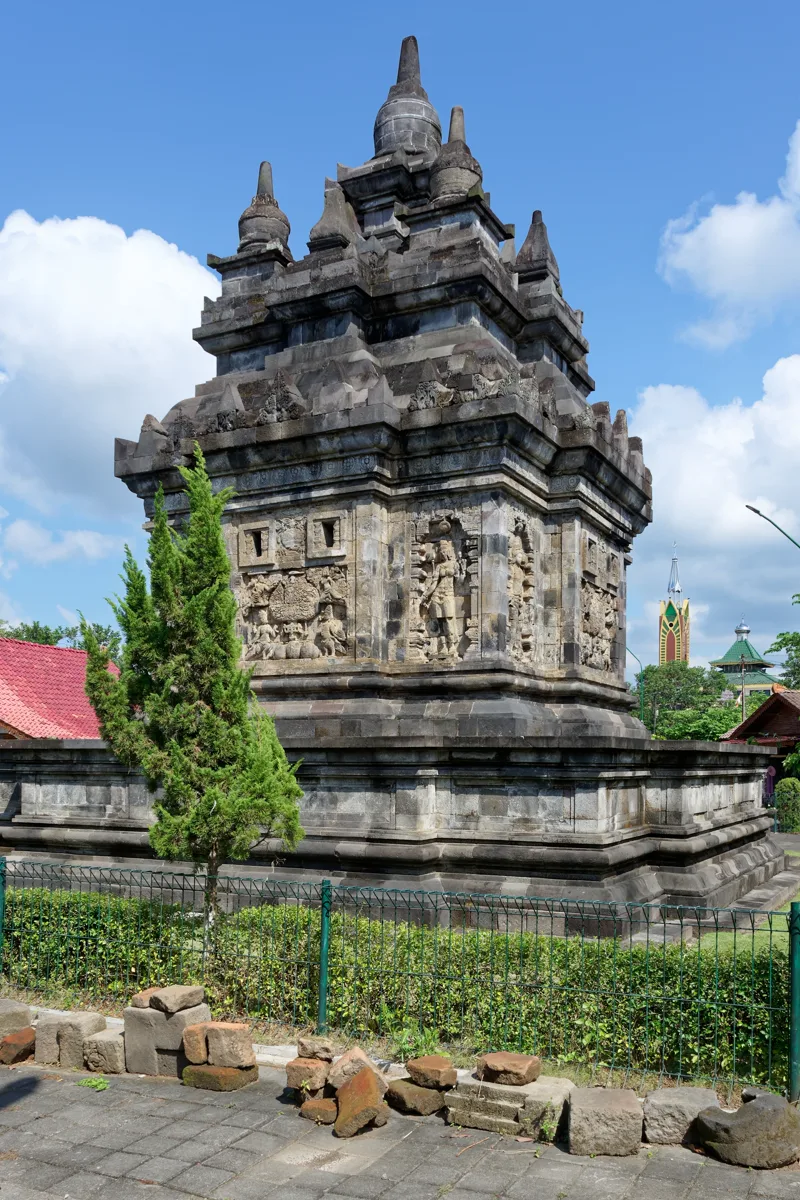
- A 20-cornered platform. The temple stands on a rectangular base rising about 1.5 m from the ground, but the edge of the platform is curved, so the outline reads as a many-cornered form rather than a plain rectangle. The platform sides carry flowers and clinging vines. This is the feature that most rewards a walk around the building rather than a photograph from the front.
- A slim body. Where the Central Javanese temples are typically squat and pyramidal, Pawon is relatively slender, closer in proportion to a Hindu temple. Combined with the curved base, it looks lighter than its neighbours.
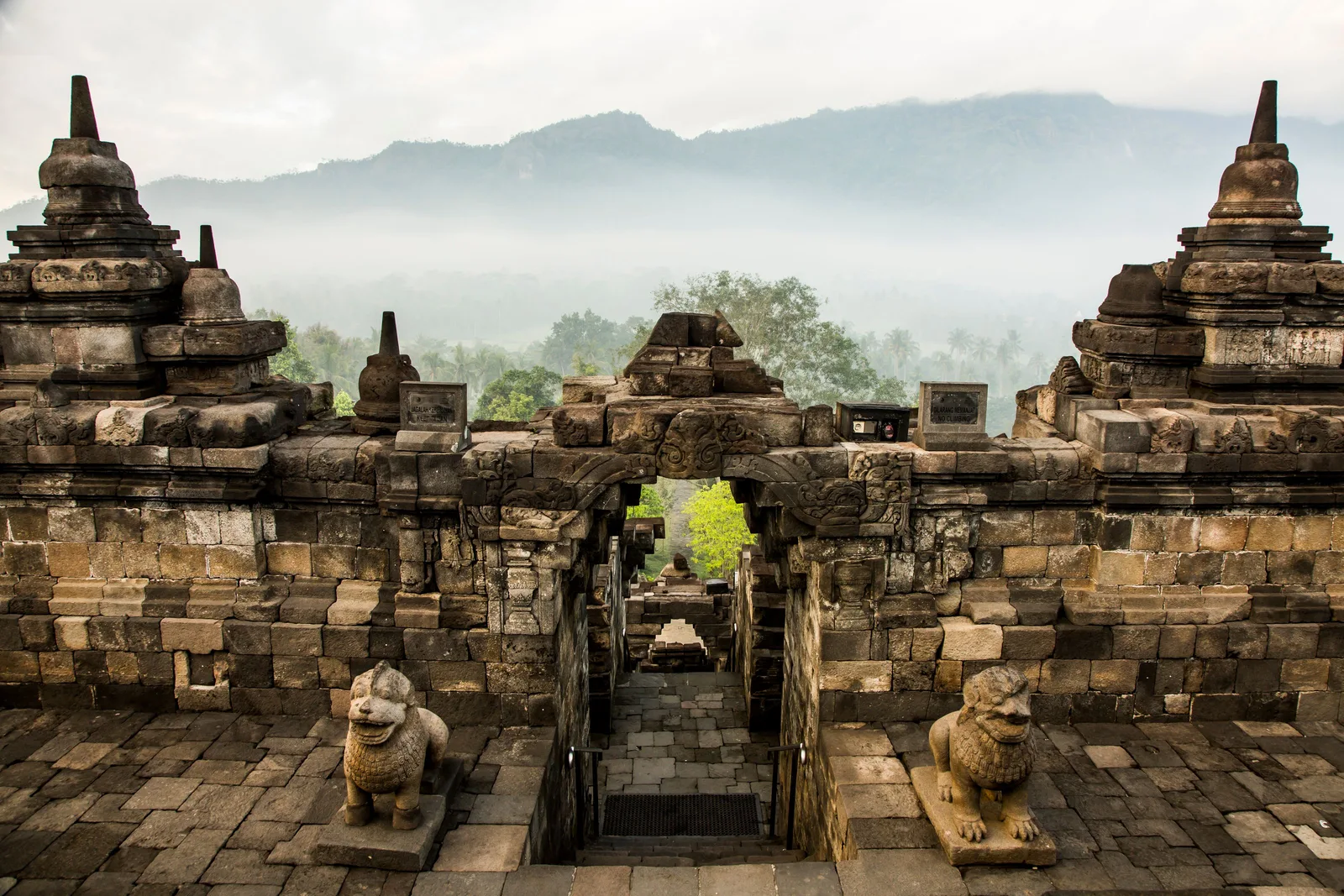
- Kala-Makara over the entrances. Carved at the top of the gates and on both sides of the stairs, as in classic Javanese temples. One account notes that the lower jaw is missing, and reads the open mouth as the Cosmic Mother drawing the universe in.
- Bodhisattvas and taras on the outer wall, with Kalpataru, the tree of life, flanked by Kinnara and Kinnari figures. That paired motif is not unique to Pawon — you will also meet it at Borobudur, Mendut, Sewu, Sari, and Prambanan — which is a useful reminder that these temples were built by people drawing on one shared visual vocabulary rather than inventing something new each time.
- Five small stupas and four small ratnas on the roof, the stupas slightly different in shape from those at Borobudur.
The combination of simplicity, symmetry, and proportion is why historians have called it the jewel of Javanese temple architecture, and why the praise is usually followed by a contrast with the tall, slender East Javanese style of the later Singhasari and Majapahit periods. It is small, it is nearly complete, and nothing is fighting for your attention. That is a rare combination in Java and worth appreciating on its own terms rather than as a lead-in to something bigger.
On age: the detail and style of the carving are generally read as putting Pawon slightly older than Borobudur. It was restored in 1835, with the work attributed to Sir Thomas Stamford Raffles, and the architect recorded in the same sources as for Mendut, Gunadharma.
The bearded dwarfs over the door
If you look above the entrance, you may notice carved figures with pot bellies, tipping out rings and other small objects from bags. This detail has done a lot of work in the interpretation of the temple.
Those dwarfs pouring riches are read as pointing to Kuvera, the Buddhist god of fortune and wealth, which supports the Britannica line about a temple of the god of wealth and the anteroom function. Both Lonely Planet and the art historian Kempers noted the motif, in 1959. Kempers was careful, though: he pointed out that there is no clear indication the temple should be considered dedicated to Kuvera, and observed that the small windows are merely decorative and seldom seen in temples.
So: a real observation, a natural reading, and a scholar immediately warning you not to treat it as settled. It is a good example of how a piece of visual evidence gets promoted into a fact, and of why a visit is more interesting once you know which parts of the story are load-bearing and which are not.
Where it fits in the order of the day
Pawon works best when it is sequenced rather than visited on its own, which is why the Mendut guide and the Borobudur temple guide matter as much as this page does.
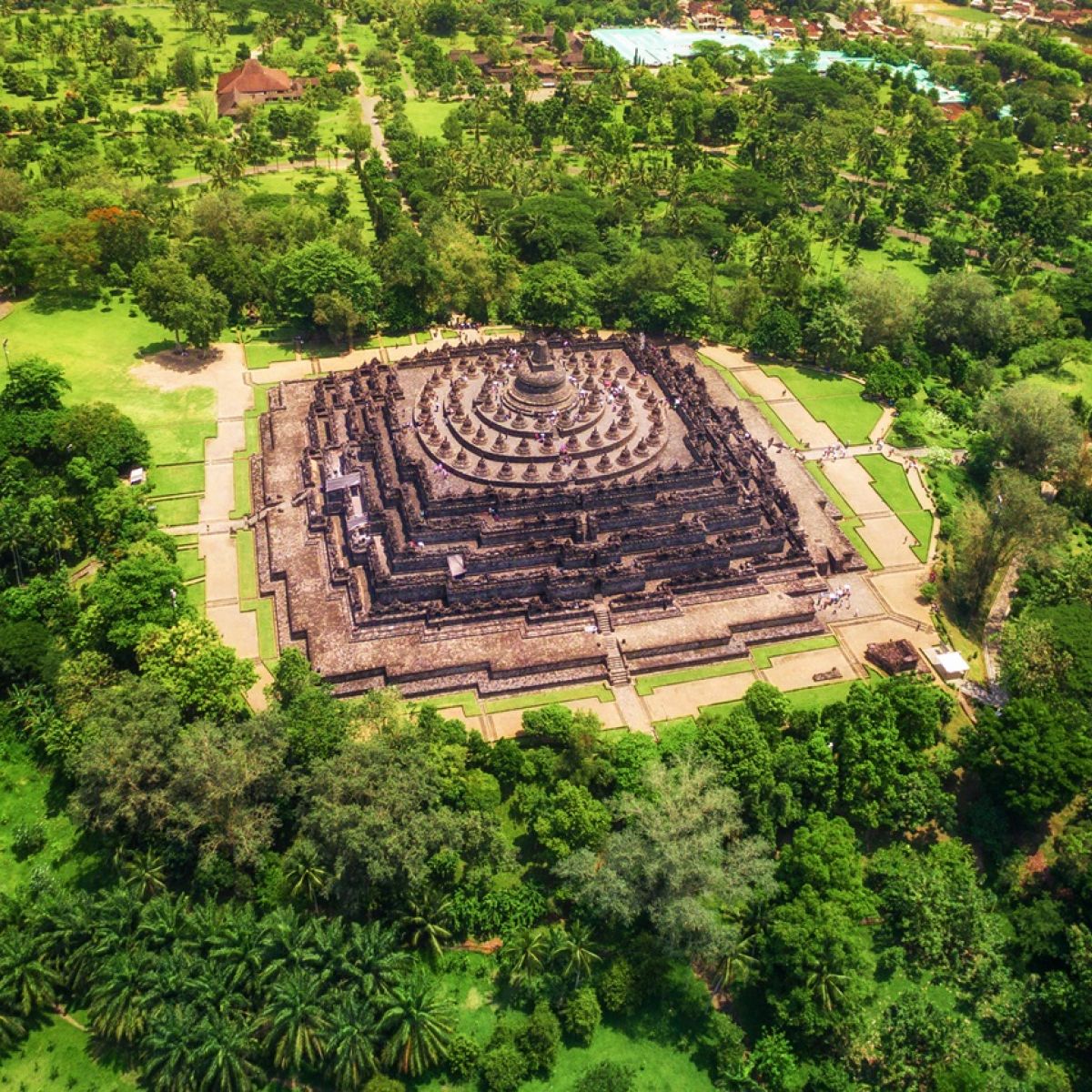
A workable order is Mendut, then Pawon, then Borobudur, moving east to west along the axis so the two small temples are done before the heat and the crowds build at the main monument. At about 2.9 km end to end, this works either as a loop with transport between sites or, depending on current access, as a walk or a bicycle ride.
Two honest cautions. First, do not assume the whole axis is a signed, walkable visitor route — check locally, and do not plan to walk a road with no shoulder. Second, do not assume a Borobudur ticket covers Pawon. All three share one UNESCO listing, but heritage designation and ticketing are unrelated arrangements.
There is a reason this route works so well, and it is older than tourism. In earlier centuries a broad road ran from Borobudur’s eastern entrance to Mendut, passing through Pawon, lined along its whole length with walls, towers, niches, and sculptures. The temple was not beside the pilgrim path; it was on it. The modern Vesak procession still walks Mendut, through Pawon, to Borobudur on the full moon in May or June, following that line. If you happen to be in the region for Vesak, this is the sequence to understand before you go — and the arrangement on the day is significantly different from a normal visit.
If you have a vehicle and the patience, Banon is a small 8th-century Hindu temple a short way north of Pawon, with reliefs of a man and a woman and a row of slender stupas. It is among the least visited and least documented candi in the region, so access and condition can be inconsistent. Treat it as a bonus rather than a plan.
For ticketing across the whole area, the Borobudur tickets and Structure Climb guide is the one to check. For timing your visit around the weather, see the best time to visit Magelang guide.
Respecting the site
Follow posted guidance and staff direction. Keep voices low, do not climb or lean on the stonework, and ask before photographing people or religious activity. Note that the small windows and the carved surface here are exactly the kind of detail that damage easily and irreparably. Clothing should be suitable for walking and appropriate to a sacred setting — see the Borobudur rules and etiquette guide for what is and is not required.
Hours, admission, footwear arrangements, and photography policy all change. Confirm them with an official or local source rather than repeating a figure from an older article.
A small preparation list
- Water, sun protection, and a rain layer.
- Saved transport and contact details on your phone before leaving Wi-Fi.
- A small bag for your own waste.
- Time to stop if weather, a ceremony, or staff guidance calls for a change.
If you have the time and want a fourth small temple, Candi Ngawen is about 6 km further east of Mendut and is even quieter, with a detail on its corner lions that has no parallel at Pawon. The sustainable travel guide covers how to visit temples with less waste and more respect for the people hosting you.
Sustainable Tip
Mendut, Pawon, and Borobudur sit on one straight line. Seeing all three in a single loop is less wasteful than running three separate car trips across the same area.
Family Tip
Pawon pairs well with Mendut. Mendut is enterable and interesting to look inside; Pawon is small and quick. Together they make a heritage morning that works with children without the scale of Borobudur.
Food Note
Most visitors photograph Pawon from outside and move on. The interesting part is the empty chamber and the basin in the middle of it: this is the one temple on the axis where nobody agrees what the room was for.
Frequently asked questions
Is Pawon the exact midpoint between Mendut and Borobudur?
No, and it is worth correcting because many sources repeat it. Published distances disagree about which gap is longer, but under every reading Pawon sits roughly 300 m off the true halfway point of the 2.9 km line. It is in the middle of the sequence and in the middle in spirit, not in the middle in metres.
What was worshipped at Pawon?
This is genuinely unresolved, and there is no single responsible answer. Competing readings make it a mortuary shrine holding a king's ashes, a fire temple dedicated to Acala, a shrine to the god of wealth Kuvera, and a purification pavilion for pilgrims ascending Borobudur. UNESCO notes that the inner space does not identify the deity, and there is no main statue.
Why is there a square basin in the middle of Pawon?
It is the most important object in the building and nobody is certain what it held. Water in a stone basin is consistent with ritual washing, which is why the purification-pavilion reading is popular. It is equally consistent with a working kitchen, which is what the name means. The basin is the physical reason the chamber cannot be read with confidence.
What does the name Pawon actually mean?
Pawon is Javanese for kitchen, and it is usually traced to a root word for dust, which produces a reading of a temple holding the ashes of a cremated king. Dutch archaeologist J. G. de Casparis connected it to a shrine for King Indra, father of Samarrattungga. Locally the temple is also called Bajranalan, from Sanskrit for the flaming thunderbolt, a weapon of Indra. The original name is genuinely unknown.
Is there anything to see inside Pawon?
There is a small inner chamber you can enter, and the basin in the middle of it. What you are looking at is the architecture and the space itself, which is the point. Pawon rewards a slow look rather than a long visit. For an interior with statues worth time, go to Mendut, which is a few hundred metres further east.
Is Pawon included in the Borobudur entrance ticket?
Do not assume so. All three temples share one UNESCO listing, but heritage designation and ticketing are separate arrangements and the small temples are not always sold together with the main monument. Confirm current admission arrangements with the operator before you travel.
How long should I spend at Pawon Temple?
Fifteen to thirty minutes is enough. It is a small monument with a lot of detail per square metre but no long narrative to read, so treat it as a pause in the heritage route rather than a destination. Mendut and Borobudur deserve more of your day.
What is Banon, and is it worth stopping for?
Banon is a small 8th-century Hindu temple a short way north of Pawon, with reliefs of a man and a woman and a row of slender stupas. It is one of the least visited candi in the region and the least documented, so conditions and access can be inconsistent. Go if you have time and a vehicle, and treat it as a bonus rather than a plan.
Tourism information — including opening hours, entrance fees, and transport routes — may change. Please verify with official local sources before planning your visit.
Sources and further checks
Use these primary or specialist sources to confirm current access rules, safety notices, and travel arrangements.

About the Author
Larasati Wulandari
Independent travel writer · Central Java, Indonesia
Larasati Wulandari is an independent travel writer who has lived in Central Java for eight years. She writes first-hand, practical guides to Magelang's temples, viewpoints, and local food, and reviews them regularly as conditions change.