 Save
Key facts at a glance
- Wettest months
- January to March, at roughly 390 to 420 mm each
- Driest month
- August, at roughly 45 to 70 mm
- Clearest window
- Roughly late April to around 20 October
- Rainy days a year
- About 268 days with measurable rain, dry season included
- Temperature
- Roughly 18 to 28 C all year, so this is a rain question, not a heat one
- Best for viewpoints
- August to September, but visibility still varies daily
- Biggest regional factor
- Haze from regional burning can grey out views for weeks
- Waisak Day
- An Indonesian public holiday, so late May is busy
Figures change without notice — treat this as a planning summary and confirm against the sources listed below.
There is no universally perfect month for Magelang, and any article that tells you there is is selling you a package. The region has two distinct seasons, and the honest answer depends on what you actually want out of the trip.
The useful way to think about it: the choice is not really about dates. It is about whether your trip depends on seeing something at a distance.
The two seasons, plainly
Magelang is in Central Java’s tropical highland zone, with a wet season running roughly November to March and a dry season roughly April to October.
Wet season (November–March). Rain is frequent, often heavy and often in the afternoon, but it is not continuous. The heaviest period is roughly December to February. The defining characteristic for a visitor is not getting wet — it is not being able to see anything far away.
One nuance in favour of anyone who dreads wet-season travel: in the wettest months, roughly 27 to 29 days out of 31 have measurable rain, but that count is not a count of unusable days. Rain in this region is overwhelmingly convective — the kind that builds over a hot day and falls in the afternoon or evening — so an early start frequently gets you your outdoor hours and an afternoon shower rather than a washout. Treat any single day as a coin flip, and treat a week as likely to contain several workable mornings. Do not, however, plan a viewpoint that depends on a specific horizon for a specific hour, because you cannot bank on the pattern holding.
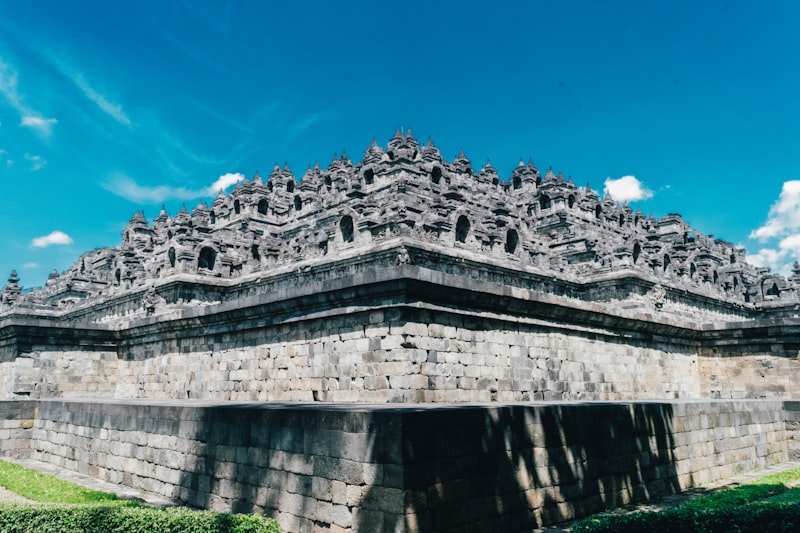
Dry season (April–October). Rain becomes rare and the visibility problem largely disappears. The tradeoff is heat: the sun is intense, and places like the Borobudur structure have no shade at all. Late dry season, around August and September, is the most reliable for views and the hottest.
Use the current BMKG forecast and warnings before each outdoor day. Conditions such as rain, lightning, fog, heat, wind, or road disruption can change what is sensible at a viewpoint or highland destination, and a forecast matters more than any seasonal promise.
The numbers, and why two sources disagree
Published climate normals for Magelang put annual rainfall at roughly 3,000 to 3,260 mm spread over about 268 days with measurable rain. Monthly figures land approximately like this:
| Month | Rainfall | Days with rain | Note |
|---|---|---|---|
| January | ~420 mm | ~29 | Wettest by volume on one dataset |
| February | ~410 mm | ~27 | Wettest on another dataset |
| March | ~390 mm | ~29 | |
| April | ~310 mm | ~26 | Warmest month, and the cloud clears |
| May | ~165 mm | ~21 | |
| June–September | ~45 to 110 mm | ~7 to 16 | The reliable window |
| October | ~200 mm | ~20 | Rain returns |
| November | ~360 mm | ~28 | |
| December | ~410 mm | ~29 |
The wettest month is genuinely disputed, and the reason is instructive. One 30-year dataset (1990–2020) names February as the wettest month. Another set of normals (1991–2020) names January as the wettest by volume while simultaneously identifying February as the month with the highest chance of rain on any given day. Both can be true, because highest monthly total and highest daily probability are different measurements. The practical conclusion is boring and reliable: December to March is the wet core, and it does not matter much which end of it you call the worst.
Two more figures are worth holding onto. The three wettest months deliver roughly 40 percent of the year’s rain, so the wet season is genuinely concentrated rather than evenly spread. And the clearer part of the year runs from roughly 26 April to 20 October — about 5.8 months — which is a tighter window than “April to October” implies.
Temperature is not the variable here
Most “best time to visit” pages default to recommending summer, because that is the reflex for the Mediterranean. It is the wrong reflex for Central Java. Magelang sits at around 379 m elevation and its temperature barely moves across the year: roughly 18 to 28°C, with April the warmest month and July the coolest, and nights running about 4°C below daytime highs throughout.
So the choice of month is essentially a choice about rain and visibility, not warmth. There is no cold season to avoid and no heat to escape. Someone who finds August too hot can visit in March with almost no temperature cost, and someone who wants the clearest views cannot improve on August–September by waiting for a cooler month, because none exists.
This is also why the wet season is not automatically a bad choice. A visitor in February experiences almost exactly the same temperatures as a visitor in August, just with more rain between them.
The factor nobody mentions: haze
This is the most important caveat in any guide about when to visit Magelang, and it is worth understanding before you pick dates.
Regional agricultural burning produces haze that can spread across Central Java and grey out long-distance views for extended periods. It is seasonal — it tracks the dry season — but it is unpredictable, and it can persist for weeks at a time.
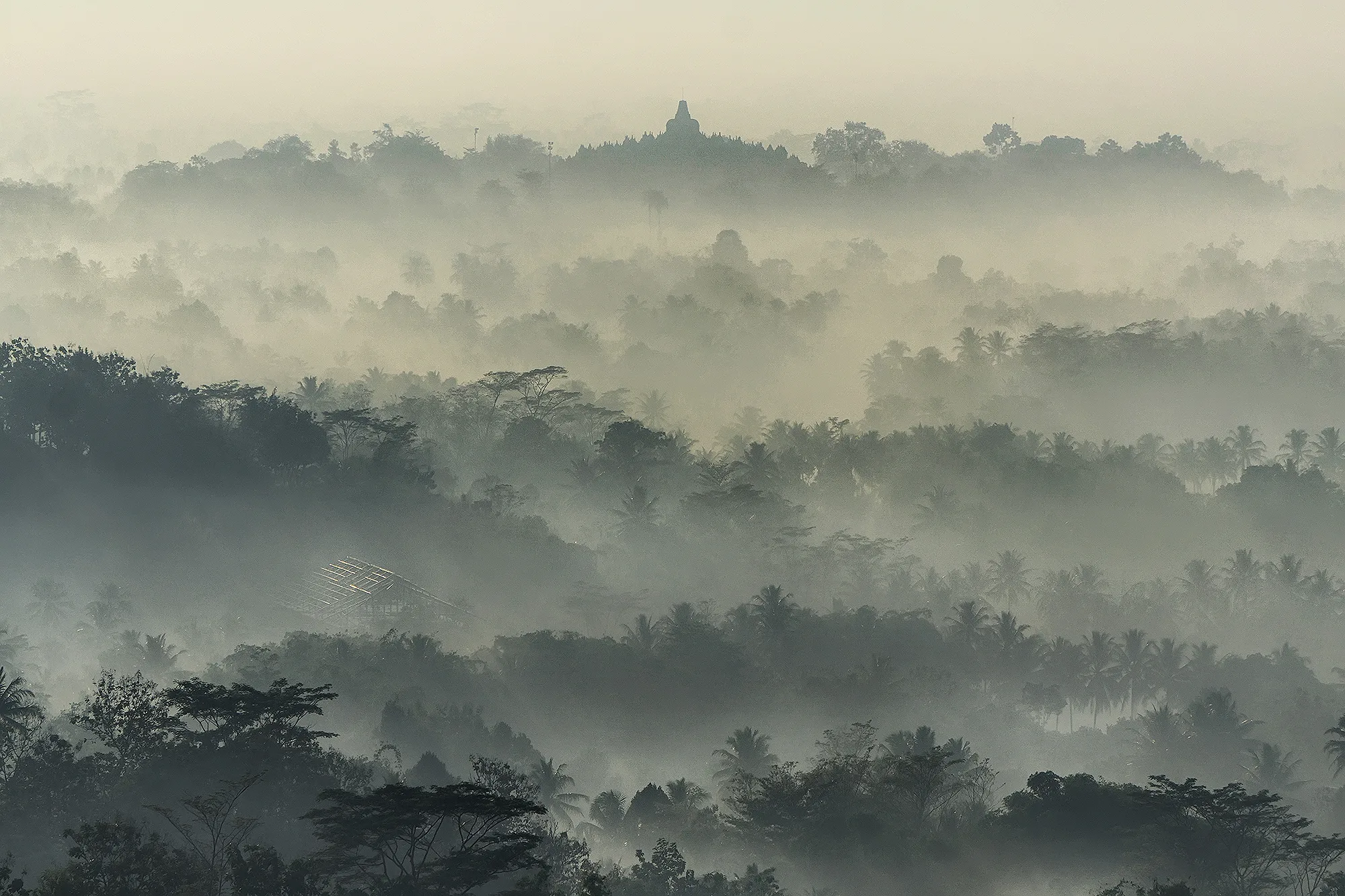
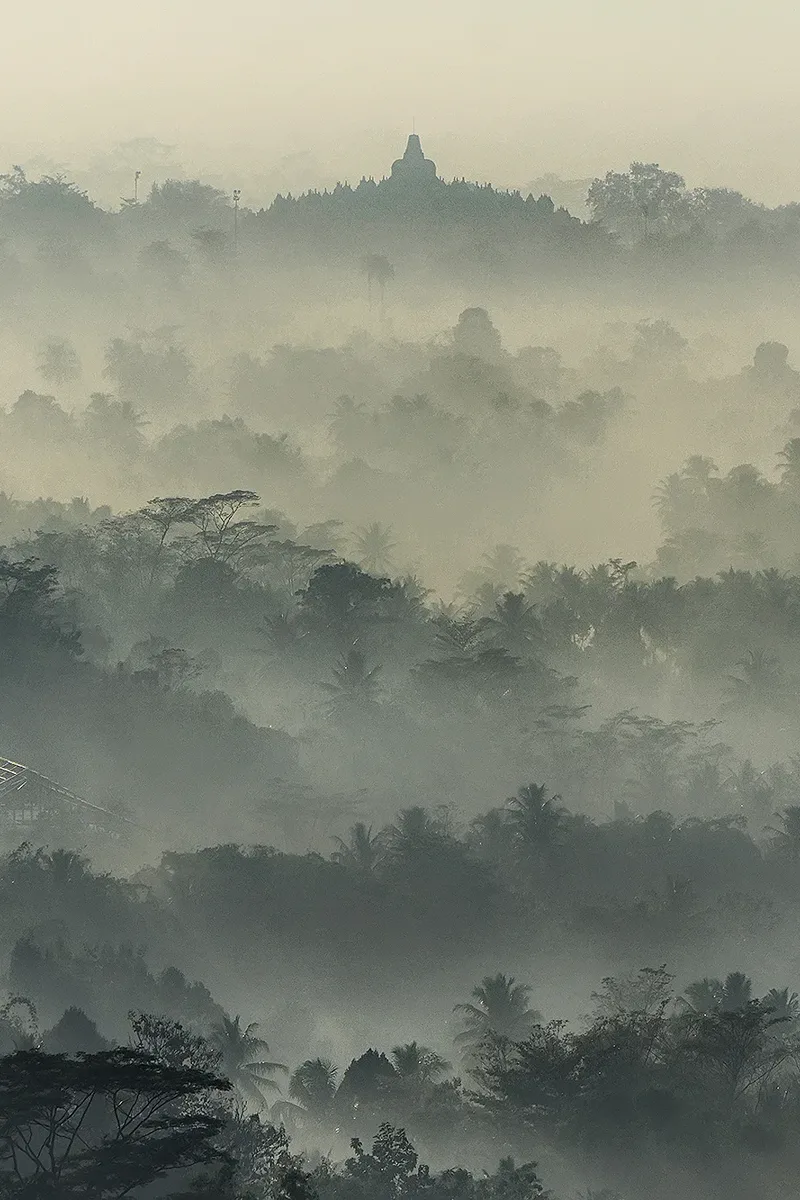
The consequence: you can arrive in peak dry season, on a cloudless day, and see nothing beyond the near hills. Punthuk Setumbu and Ketep Pass both depend on long-distance visibility, and haze defeats them just as thoroughly as cloud does.
There is a useful irony in the data here. August is simultaneously the driest month and the month with the clearest skies — around 67 percent cloud cover, against 92 percent in January. But August is also inside the window when regional burning is most likely, so the clearest month on a cloud chart is not reliably the clearest month to look at. Cloud and haze are separate problems, and solving one does not solve the other. A forecast that promises a sunny day tells you nothing about the air.
Practical advice: check current haze and air quality reports alongside the forecast in the week before you travel, and keep some slack in your plans for a week where the views simply do not happen.
One thing to get out of the way early, because it affects what you buy: no camera filter removes haze. A polarising lens helps with light reflected off water, wet leaves and glass, which is genuinely useful, but agricultural haze is fine particulate suspended in the air and a filter does not touch it — at best you get a small contrast gain for roughly two stops of light you needed at dawn. The haze is a timing problem, not a filter problem. Our camera gear note sets out what each piece of kit does and does not solve here.
Best time by priority
For clear landscape views and photography → late dry season, August to September. The highest probability of both clear skies and clear air. It is also the hottest and most crowded period.
For temple visits with children or older travellers → the shoulder months, November or March. You get most of the dry season’s usability, softer light than peak summer, fewer visitors, and lower prices. This is the best-value window in the year.
For culture and crowds → the Waisak full-moon festival, but only deliberately. Thousands of monks and pilgrims process from Mendut to Borobudur. It is a living ritual and a genuinely moving thing to witness, but visitor arrangements change substantially, crowds are extreme, and it is not a calm introduction to the area. If Waisak is not specifically what you came for, avoid that period — and see the calendar section below for why it affects more than that one day.
For food, indoor workshops and slow travel → the wet season is genuinely fine. Getuk, soto and nasi lesah, the batik and rengginang workshops at Wanurejo, and the enterable interior at Mendut do not depend on the sky. The rainy season guide covers this in detail.
The calendar is not just weather
Weather is only one of the two things that should shape your dates. The other is the Indonesian public holiday calendar, and it has a habit of clustering.
Waisak Day is the one that matters here, because Borobudur is its centre. It is a national public holiday, not a fixed date: it falls on the full moon of the lunar month Vesakha, so it moves between April, May and June each year. Recent and expected dates are 12 May 2025, 31 May 2026, 19–20 May 2027, and roughly 9 May 2028 — all provisional beyond the near term, and all of them should be confirmed for your year of travel. Because it is a public holiday, it is frequently extended by a cuti bersama joint-holiday day, which turns a single date into a multi-day break. In 2025 it fell on a Monday and in 2026 on a Sunday, which in practice means a two-day weekend either way.
The 2026 celebration is worth describing because it shows how unusual the timing can get. The full moon on 31 May 2026 was simultaneously a blue moon — the second full moon in a single calendar month — and a micro moon, meaning the moon was near the far end of its orbit and appears unusually small. Around 2,570 lanterns were released at Borobudur, and the commemoration was organised by the Indonesian Buddhist Representative Council (WALUBI) and the Indonesian Mahanikaya Buddhist Religious Council (MBMI) with central and regional government support. A micro moon is a slightly smaller-looking full moon; against a temple silhouette at dawn that is a real if subtle difference, and it is the kind of detail that makes the effort of being there worthwhile.
The more practical point is clustering. In 2026, Waisak on 31 May sat directly between Idul Adha on 27–28 May and Pancasila Day, the national holiday marking 1 June. That is a three-holiday cluster inside five days, and it meant late May 2026 was considerably busier and more expensive than an ordinary May would suggest — a fact invisible to anyone who only checked the weather. The same pattern applies elsewhere in the year: Idul Fitri in March, and the year-end period are the other two windows when domestic travel, road transport and rooms are under the most pressure.
So the practical rule is: when you pick your dates, check the Indonesian public holiday calendar as well as the forecast. A month that looks ideal on paper can be unexpectedly busy.
Heritage visits: comfort over calendar
Heritage sites reward a slower pace more than a particular date. Visit Borobudur, Mendut, and Pawon when your group can manage heat, walking, queues, and current visitor rules without rushing.
An earlier start makes the day calmer and gives better light, but it is not a guarantee of empty paths or cool conditions. Carry water, wear comfortable clothing that suits site guidance, and keep your plan flexible if current access, ceremonies, or weather change the pace.
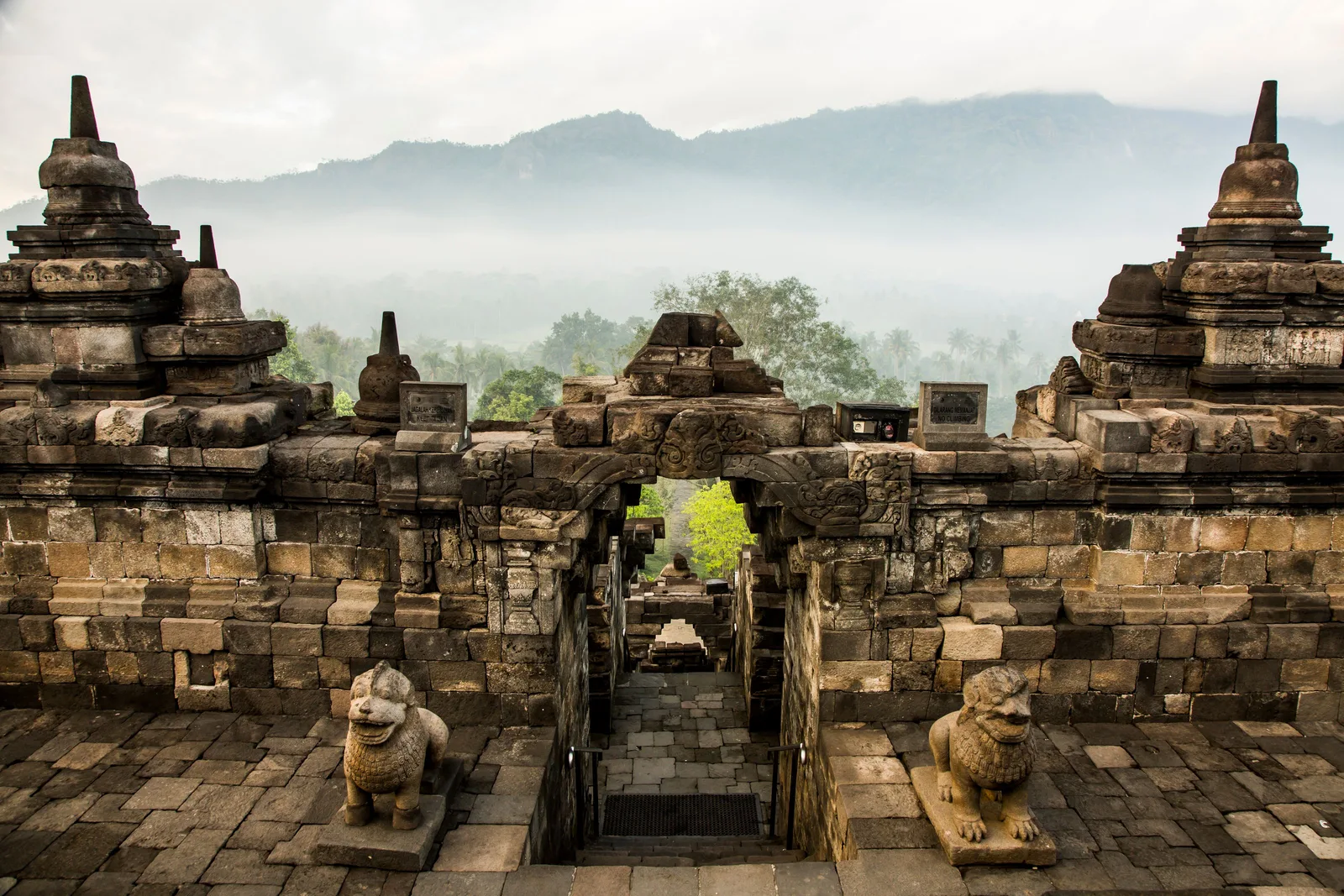
One wet-season detail worth knowing: the stone stairs on the Borobudur structure become slippery in rain, and staff may close the structure. The grounds remain open. So a wet-season visit is often a good grounds-and-Mendut visit rather than a structure climb.
Viewpoints: treat visibility as a bonus
Punthuk Setumbu and Ketep Pass are entirely condition-dependent. No article, booking, or early wake-up can promise a clear sunrise or mountain view.
Choose a day when you can change plans without losing the whole trip — which is another argument for the shoulder months, where a disappointing weather day is less likely. Confirm the forecast close to departure, travel safely in low light, and have a food, heritage, or rest-day alternative ready. For volcanic landscape plans, official safety information from MAGMA Indonesia must always override a sightseeing schedule.
Waterfalls and highlands: the one case rain helps
The wet season is genuinely the right season for Kayang Waterfall. More rain means more water, which means a stronger flow and a better scene. The cost is trail condition — steps get slick, paths get muddy, and flash runoff is a real risk after heavy rain.
The same applies to the highland village areas around Nepal Van Java. Confirm present local conditions, follow site guidance, and do not continue if the route feels unsuitable for your group.
Best time of day
Whatever month you choose, early morning is consistently the best, and it is the only time viewpoint photography works at all.
It is cooler, the light is better, crowds are thinner, and the air is clearest in the first hour after dawn. The tradeoff is a pre-dawn start on a narrow, unlit hillside road, which is a genuine safety consideration rather than a minor inconvenience. Read the Punthuk Setumbu guide before committing to a 4am departure.
Make your dates work for you
Rather than planning every hour around weather-sensitive photography, choose a trip structure that can adapt. Give each day one main priority and at least one fallback. That single rule does more for trip quality than any date choice.
The one-day Magelang itinerary gives a compact framework, the two-day itinerary adds a dawn start, and the three-day itinerary leaves the most room for weather changes. The Magelang budget guide covers how season affects what things cost.
Before departure, check the forecast, local alerts, visitor rules, and transport conditions. A well-timed visit is not about predicting the sky perfectly; it is about having a plan that remains enjoyable when conditions change.
Sustainable Tip
Choose one weather-sensitive activity per day and accept an alternative rather than making repeated drives to chase a view. Every failed second attempt is extra fuel and extra pressure on the same hill.
Family Tip
For children, plan shade, water, food, and an indoor or low-effort backup before committing to any early start. The dry season widens your options considerably; the wet season requires you to design the fallback in advance.
Food Note
The shoulder months at either end of the wet season — around November and March — are the sweet spot. You get most of the dry season's reliability with none of the August crowds, and the light is often softer than the harsh midday sun of peak dry season.
Frequently asked questions
What is the best month to visit Magelang?
For viewpoints and photography, late in the dry season around August or September gives the best odds. For temple visits specifically, any month works, and an early start avoids the worst heat. There is no single correct answer because the region has two distinct seasons and variable haze.
Is Magelang closed during the rainy season?
No. The sites stay open through heavy rain. What changes is that the exposed stone structure at Borobudur is frequently unusable, viewpoints are usually clouded, and waterfall trails get slippery. A wet-season trip is a good cultural trip and a poor photography trip.
What is the wettest period in Magelang?
Roughly December to February is the wettest part of the season, with heavier rain more frequent. November and March sit at the edges and are often more usable than the middle of the season.
Can I see Mount Merapi and Merbabu from Ketep Pass in the wet season?
Sometimes, but you should expect not to. Cloud and rain frequently hide both volcanoes between November and March. Treat Ketep Pass as an optional part of a wet-season trip rather than a reason to make the journey.
Why do the views look grey even on a dry day?
Regional agricultural burning produces haze that can spread across Central Java and grey out long-distance views for extended periods, sometimes weeks. It is seasonal and unpredictable. Check current air quality and haze reports alongside the forecast.
Is the dry season the only comfortable time to climb Borobudur?
No. The monument is open year-round. What changes is that in the wet season the stone stairs are wet, slippery and more dangerous, and staff may close the structure. In the dry season the issue is heat instead, since the monument has no shade.
Should I visit during the Vesak full-moon festival?
Only deliberately. Vesak brings thousands of monks and pilgrims processing from Mendut to Borobudur, which is a genuine cultural experience, but visitor arrangements change substantially and crowds are extreme. If it is not your priority, avoid that period.
Is the dry season actually rain-free?
No, and this is the most common misreading of a dry-season recommendation. Magelang records measurable rain on roughly 268 days a year averaged across the year, so even the driest months are not dry every day. Drier means less, not none. Pack a light layer you can carry for a 20-minute shower even in August.
When is Waisak, and should I plan around it?
It is an Indonesian public holiday rather than a fixed calendar date, so the date moves each year. Recent and expected dates: 12 May 2025, 31 May 2026, 19 to 20 May 2027, and about 9 May 2028. Because it is a public holiday it is often extended with a cuti bersama joint-holiday day, which effectively creates a multi-day break. Treat late May as busy and confirm the exact date for your year.
What is the best time of day in Magelang?
Early morning, consistently. It is cooler, the light is better, crowds are thinner, and it is the only time viewpoint photography works. The tradeoff is the pre-dawn start on a narrow hillside road, which is a real safety consideration.
Tourism information — including opening hours, entrance fees, and transport routes — may change. Please verify with official local sources before planning your visit.
Sources and further checks
Use these primary or specialist sources to confirm current access rules, safety notices, and travel arrangements.
- Indonesia Meteorology, Climatology, and Geophysics Agency (BMKG)
- UNESCO: Borobudur Temple Compounds
- Indonesia's official tourism portal
- Climate normals and monthly rainfall data for Magelang
- Magelang rainfall and temperature overview (30-year averages)
- Indonesia public holiday calendar (Waisak and clustering)
- ANTARA: Vesak Day 2570 BE at Borobudur, 31 May 2026

About the Author
Larasati Wulandari
Independent travel writer · Central Java, Indonesia
Larasati Wulandari is an independent travel writer who has lived in Central Java for eight years. She writes first-hand, practical guides to Magelang's temples, viewpoints, and local food, and reviews them regularly as conditions change.