 Save
Key facts at a glance
- The four components
- Rice cake (kupat), tofu, bean sprouts, sweet-savoury sauce
- What the sauce usually contains
- In Magelang, kecap manis and fried shallots; peanuts appear at some stalls
- Usual meal slot
- Breakfast or a light meal; pair it with a warm soup
- A Magelang institution
- One of the city's oldest counters is known for homemade sweet soy
- The name
- Kupat is the Javanese word; ketupat is the Indonesian and Malay one
- Not the peanut version
- Magelang uses kecap manis; the peanut sauce belongs to West Java
- Price discipline
- Do not travel for a fixed price; costs change by vendor and location
- Allergen exposure
- Shared ladles and sauce make cross-contact likely
Figures change without notice — treat this as a planning summary and confirm against the sources listed below.
Kupat tahu is the dish most visitors encounter first in Magelang, and it is a good one to learn on because it teaches you how Indonesian street food works. Four components, one sauce, and an enormous amount of variation between stalls. It is a breakfast or light-meal dish, it is served from a basin that has been ladled out all morning, and the sauce — not the rice cake — is what you are actually here for.
The Four Components
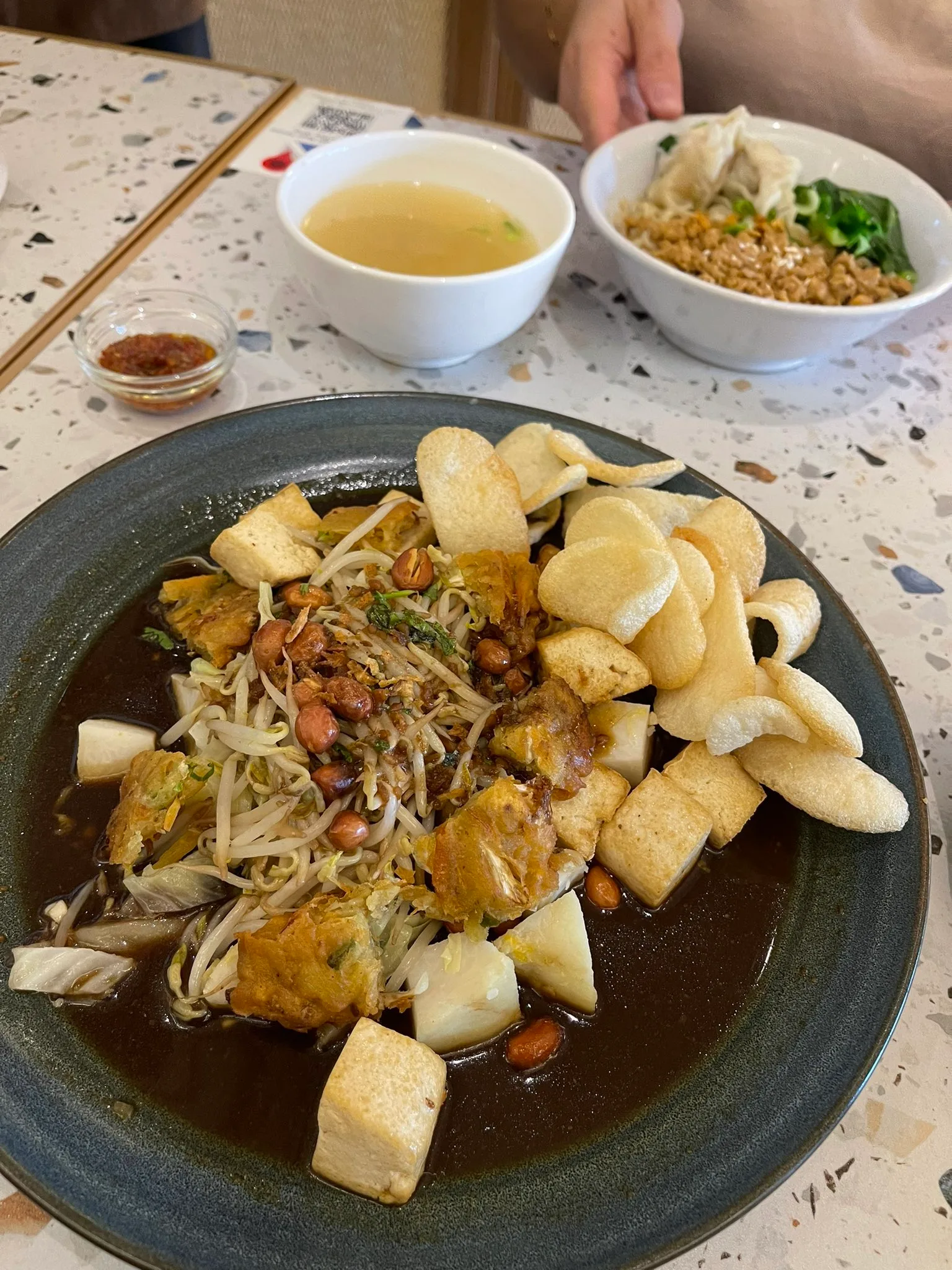
- Kupat — compressed rice cake, made by cooking rice tightly wrapped in a leaf. It is chewy, faintly sweet and holds sauce well.
- Tahu — fried tofu, added hot so it absorbs the sauce rather than staying dry.
- Kecuk — bean sprouts, usually raw, adding cold crunch to a hot, soft bowl.
- Sauce — the point of the dish.
The sauce is typically a sweet-savoury mixture built on kecap manis, Indonesian sweet soy sauce, with fried shallots on top. Many versions add peanuts, chilli, or both. What looks like a bright, appetising red or brown pool is usually quite sweet, and this is the single thing most likely to surprise you.
The Sauce Split, and Why Magelang Is Not the Peanut Version
Here is the correction that matters most, and it is one that most English-language guides get wrong. Kupat tahu is a pan-Indonesian dish, and it splits into two distinct camps that are frequently confused with each other.
The peanut-sauce camp is Sundanese and West Javanese. The canonical West Java version — roadside kupat sumpil — is served with fried tofu, rice vermicelli (bihun), bean sprouts, cucumber and the rice cake, all under a rich sweet-spicy sauce ground from peanuts, garlic, chilli, palm sugar, salt and kecap manis. The Balinese relative, tipat cantok, is closer still: sliced rice cake with vegetables, bean sprouts, cucumber and fried tofu in a sauce of ground fried peanuts, garlic, chilli, salt and tauco, a fermented soy paste.
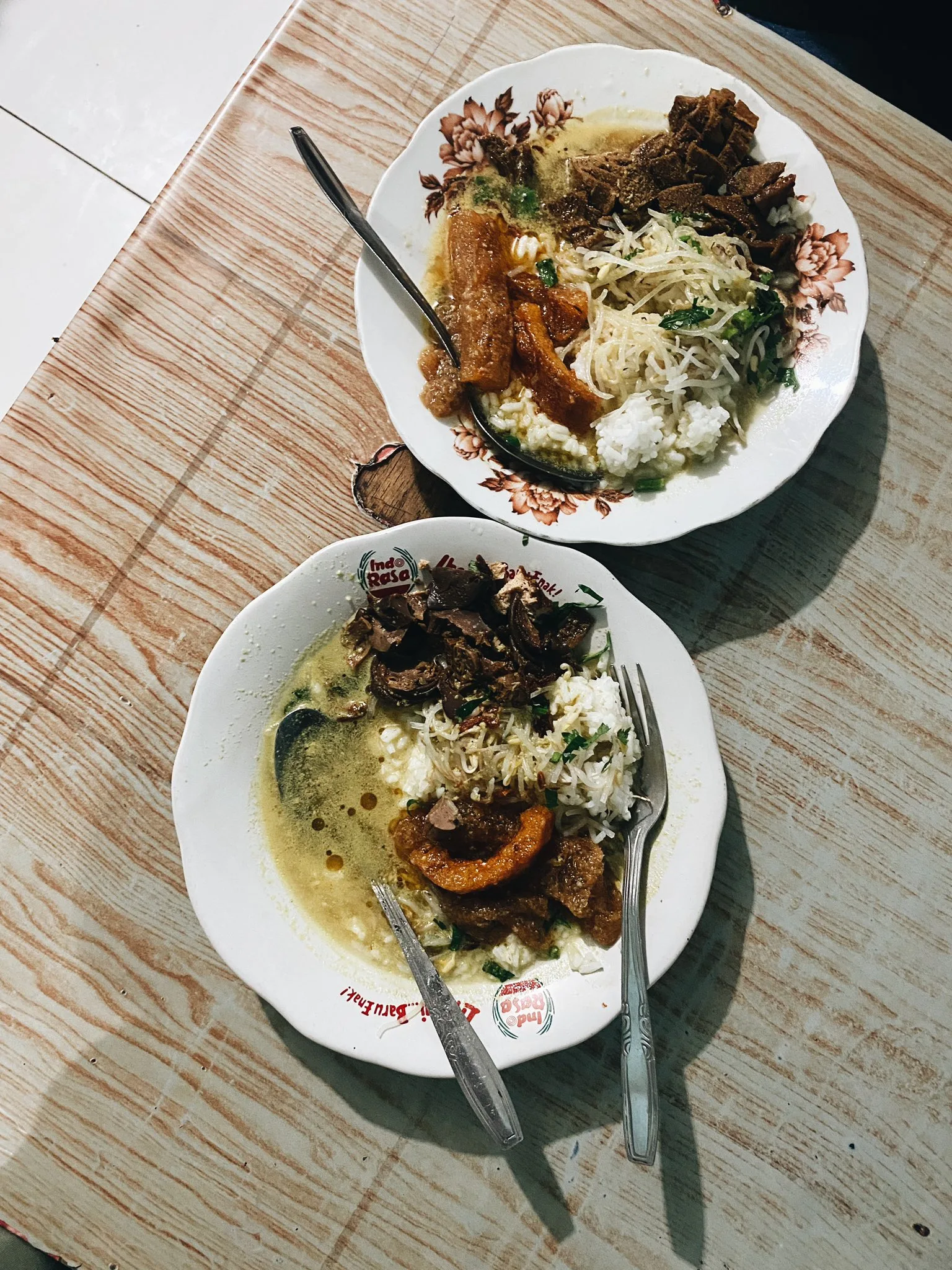
The sweet-soy camp is what you will actually eat in Magelang. Here the sauce is built on kecap manis with fried shallots, and peanuts are an optional addition rather than the base. If a photo of kupat tahu shows you a thick, opaque, tan-coloured gravy, that is a West Javanese or Balinese bowl, not a Magelang one. This is very often the source of the surprise that leads to the first line of this article — a Magelang bowl’s sauce is thin, dark, glossy and very sweet, and it behaves nothing like a peanut sauce.
The name helps you place it. Kupat is the Javanese and Sundanese word, ketupat is the Indonesian and Malay one, and tipat is the Balinese. A Javanese city calling its dish kupat is using the local vocabulary, not importing a generic national dish — which is a small sign that the Magelang version is the genuine local article rather than an imitation.
And Magelang is far from the only place that makes it. Documented variants include kupat tahu Kuningan, Padalarang near Bandung, Singaparna in Tasikmalaya, Bandung itself, Banyumas, Bumiayu in Brebes, and tahu kupat Solo from Surakarta. Each differs in sauce, toppings or accompaniments. Being “Magelang’s signature food” is a real local claim, but it is a claim within a chain that runs across Java — and the differences along that chain are the interesting part, not a footnote.
Where the Dish Actually Comes From
The rice cake is older than the religion it is now most associated with. The 9th-century Javanese epic the Kakawin Ramayana, composed during the Mataram Kingdom, contains a reference to a rice cake called kupatay — which means the practice of packing rice into woven leaf cases was already established in Java roughly a thousand years before Islam arrived.
Indonesia’s official tourism portal gives the customary account: in pre-Islamic times, people across the archipelago hung a rice cake on a buffalo’s horns as a mark of gratitude for the harvest. The tradition was later tied to Idul Fitri in the 15th and 16th centuries, with the adoption commonly credited to Sunan Kalijaga, one of the Wali Songo — the nine saints credited with spreading Islam in Java — as a way of presenting Islamic teaching in terms Javanese people already understood. Other accounts credit Raden Mas Sahid instead. Both attributions are traditional rather than documented, which is normal for this kind of religious history.
That pre-Islamic origin is why the post-Eid celebration in Central Java is called Bada Kupat, and why families there prepare ketupat and lepet together. Lepet is the stickier cousin: glutinous rice steamed in coconut milk, mixed with pandan and salt, combined with grated coconut and peanuts, then wrapped in janur in a cylinder and steamed again.
Two other neighbouring dishes are worth knowing so you can order confidently. Kupat sumpil is the Central Java roadside version with bihun and peanut sauce described above — small triangles in bamboo rather than coconut leaf. And kupat glabed, from Tegal, serves the rice cake under a thick yellow gravy, which is a different dish again.
The Meaning in the Shape
The diamond shape is not merely practical, which is worth knowing because it explains why the dish is served in halves and why you are expected to eat both.
The crossed weaving of the palm leaf is traditionally read as the mistakes and sins of human beings, and the white rice inside as purity and deliverance after the fast. The four sides are each given a name and a meaning: Lebaran, the door of forgiveness being opened; Luberan, abundance and giving alms; Leburan, the absolution of a year’s sins. The phrase attached to it is ngaku lepat — admitting one’s mistakes.
There is a local etymology that traces the words kupat and lepet to saloko lepat, meaning “mistake” in Javanese, on the theory that the dish symbolises an apology for a wrong done. Treat that as a Javanese folk etymology rather than philology, but it is a reminder that in Indonesia the shape of a food is often carrying an argument as well as a recipe.
The Wording That Matters
“Tidak pedas” — not spicy. “Sedikit pedas” — a little spicy. “Bungkus” — takeaway.
The timing matters more than usual. Tell the seller your requirement before the bowl is assembled, not after. In a busy stall the sauce is ladled in one movement and mixing happens immediately, so a request made afterwards is genuinely harder to honour. Speak slowly, point only where you have to, and repeat the request back to be sure.
If you are ordering for someone with an allergy, that is the same principle taken more seriously: ask before assembly, and expect that some vendors will decline because the ladles are shared. That is a reasonable answer, not a problem to argue with.
Choose a Stall Thoughtfully
Street food can be a good part of a trip when you use basic food-safety judgement. Choose a stall where hot food is cooked or kept hot, fresh ingredients are covered, serving surfaces look clean, and the vendor can answer a simple question about spice or ingredients. If you are unsure, choose a cooked dish rather than raw additions.
Two features of this particular dish are worth flagging. The component mix means a bowl contains both hot and cold raw elements, so it is not a dish to leave sitting out while you walk somewhere. And because the basin is repeatedly ladled from across a whole morning, a stall with high turnover is generally a better bet than one with a slow trickle.
For a genuinely Magelang institution worth knowing about, Indonesia’s official tourism portal lists a kupat tahu counter on Jalan Tentara Pelajar in Cacaban, Kota Magelang, described as one of the oldest in the city and known for its homemade sweet soy sauce. It gives historic opening hours of roughly 09:00–20:30 daily. Treat that as something to confirm on the day rather than a fixed plan.
Allergens Are Not a Small Question
This is a dish with a lot of plausible problems in one bowl. Kecap manis contains both soy and wheat. Peanut is a common addition. Some versions contain shrimp paste (trasi), which matters for vegetarians as well as for people avoiding shellfish. The bean sprouts are raw, and shared ladles make cross-contact likely across everything in the basin.
None of that means you cannot eat it. It means you should not pretend you can treat it as a neutral dish. If the answer to an allergy question is uncertain, move to something simpler rather than taking a risk. For a straightforward cooked alternative, Soto Magelang is clearer and easier to control; for a dish with no sauce-based risk at all, Nasi Langi is the safer order.
Order With Less Waste
Eat in when possible, or ask about using your own clean container for takeaway. Start with a modest portion if you are unfamiliar with the sauce or heat level — the components are filling and the sauce is very rich, so a large bowl is easily more than you want.
Do not travel for a fixed price. Costs change by vendor, ingredients and location, and published figures go stale within months. If you are working to a budget, the Magelang and Borobudur budget guide sets out what a realistic day costs and where the fixed costs actually are.
Where to Find It
Markets, local food streets, and neighbourhood warungs are better explored with up-to-date recommendations from your accommodation host or a local tourism office. Opening times and exact stalls are variable, so confirm on the day. Carry cash — many long-running stalls do not take anything else.
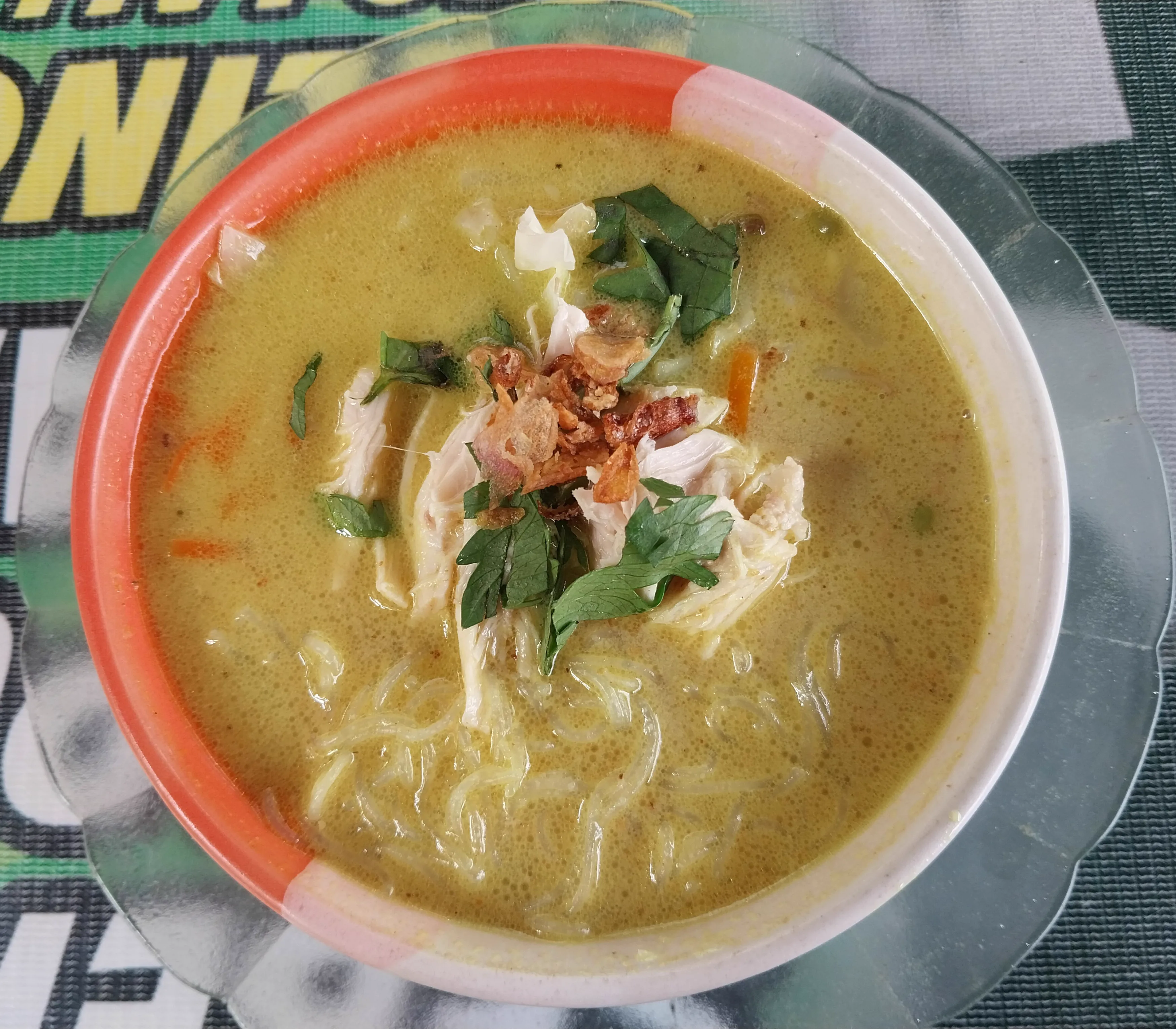
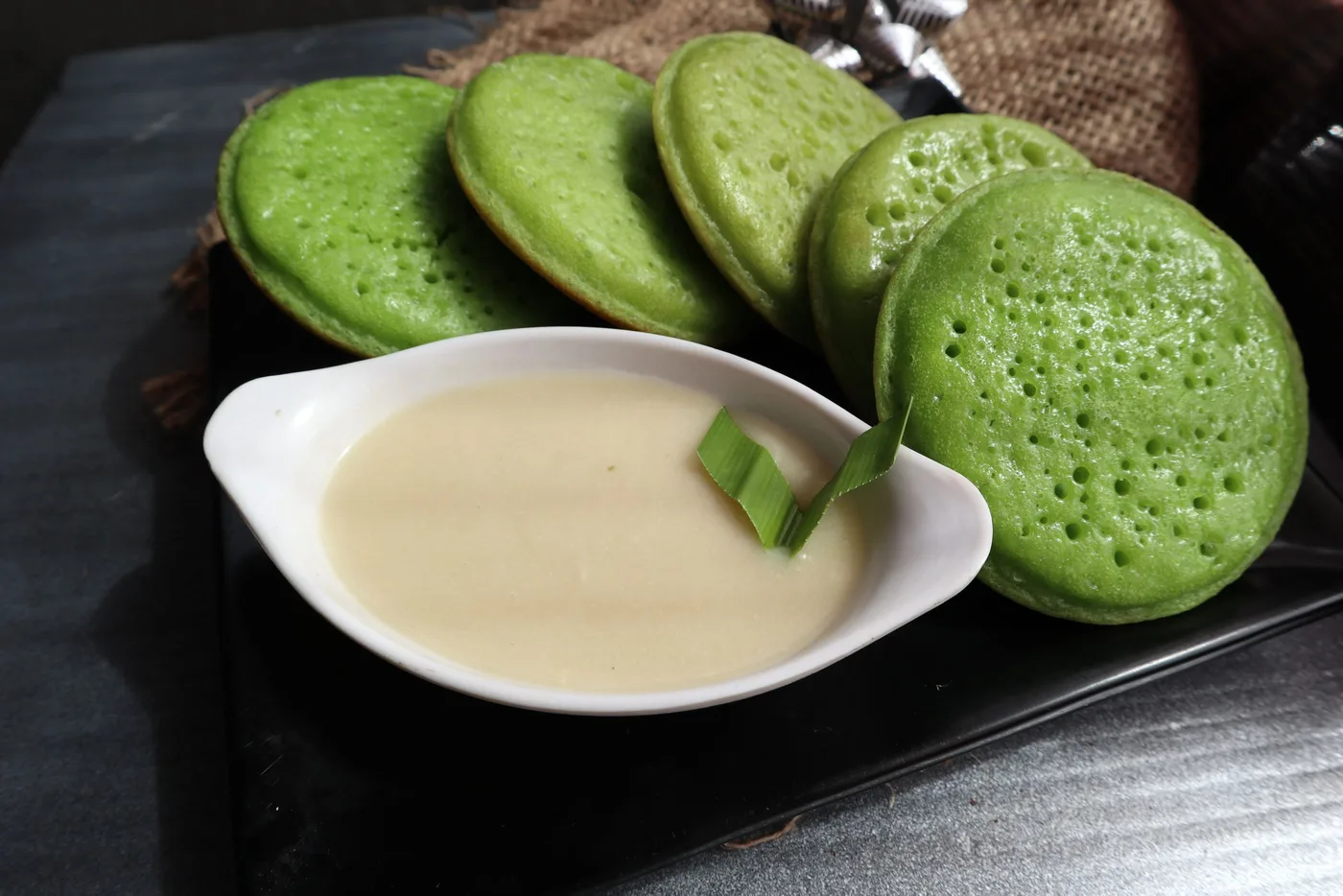
For the rest of a local-food day, compare this with Getuk Magelang for a sweet cassava stop, Serabi and Lumpur for griddle cakes, and Sop Senerek for a warm soup that pairs naturally with it. Practical choices around waste and local spending appear in our sustainable travel guide.
Sustainable Tip
For takeaway, ask whether your own clean container can be used. If not, decline unnecessary cutlery and carry packaging until you find a proper bin.
Family Tip
Ask about chilli, peanut, soy, and other ingredients before ordering for children or anyone with food allergies.
Food Note
Choose a stall based on visible hygiene, food temperature, turnover, and clear communication rather than queues alone.
Frequently asked questions
What is kupat tahu made of?
Four components: kupat, which is compressed rice cake made by cooking rice tightly wrapped in a leaf, tofu, bean sprouts, and a sauce. In Magelang the sauce is the character of the dish, a sweet-savoury mixture built on kecap manis and fried shallots, sometimes with peanuts or chilli. Note that the thick tan peanut sauce in most photos of kupat tahu is the West Javanese and Balinese version, not the Magelang one.
Why is it called Magelang's signature street food?
It is widely associated with the city, and one long-running Magelang counter is well known locally for its homemade sweet soy sauce. That continuity is what makes a street food a signature rather than just a popular dish. It is worth knowing that kupat tahu has documented variants right across Java, from Kuningan and Bandung to Banyumas and Solo, so Magelang's claim is a local one inside a wider tradition rather than a unique invention.
Is the peanut sauce version the same dish?
Related, but not the same bowl. The thick peanut sauce with bihun and cucumber belongs to the Sundanese and West Javanese version, and the Balinese tipat cantok uses peanuts with tauco. Magelang builds its sauce on kecap manis and fried shallots, so a bowl there is thin, dark and very sweet. That gap is the most common reason visitors are caught out.
Is kupat tahu spicy?
It can be, and vendors usually adjust. Tidak pedas means not spicy and sedikit pedas asks for a little. Say what you want before the bowl is assembled, because after that it is mixed in.
Is it safe to eat?
Use your own judgement and look for a stall where food is cooked or kept hot, fresh ingredients are covered, surfaces look clean and the vendor can answer a question. If you are unsure, choose a cooked dish rather than one with raw additions.
Can vegetarians or people with allergies order it?
Not without asking. The sauce commonly contains kecap manis, which has soy and wheat, and may contain peanuts; some versions use shrimp paste. Shared ladles and sauce make cross-contact likely. Tell the seller about allergies before the meal is assembled, and choose something simpler if the answer is uncertain.
Can I eat it as a vegetarian in Magelang?
Not reliably at a typical stall. If a strictly vegetarian meal matters, plan it deliberately rather than improvising — our budget guide covers how to keep a day flexible enough to change plan.
How much does a serving cost?
Treat any published figure as a historical reference. Indonesia's official tourism portal has quoted historic price bands in the low tens of thousands of rupiah for portions, but costs change by vendor, ingredients and location, so confirm on the day and carry cash.
How is it related to Eid?
The rice cake is far older than Islam in Java. The 9th-century Kakawin Ramayana already refers to a rice cake called kupatay, so the leaf-wrapping technique was established during the Mataram Kingdom. It was later associated with Idul Fitri, commonly credited to Sunan Kalijaga of the Wali Songo as a way of teaching Islam in terms Javanese people already understood. The crossed diamond weaving is traditionally read as human error and the white rice as purity, and the four sides are named for forgiveness, almsgiving and absolution.
What is the difference between the two ways it is served?
It is commonly ordered in pairs, with extra sauce or fried shallots added at the table, and it is usually eaten with a spoon alongside or under the sauce. Some stalls serve the components partly separated. Both are normal; ask if you prefer one.
Tourism information — including opening hours, entrance fees, and transport routes — may change. Please verify with official local sources before planning your visit.
Sources and further checks
Use these primary or specialist sources to confirm current access rules, safety notices, and travel arrangements.

About the Author
Larasati Wulandari
Independent travel writer · Central Java, Indonesia
Larasati Wulandari is an independent travel writer who has lived in Central Java for eight years. She writes first-hand, practical guides to Magelang's temples, viewpoints, and local food, and reviews them regularly as conditions change.